

OK. It’s the battle of the angle grinder resistant bike locks. The Hiplok D1000 vs the Litelok X1.
Which lock is the most secure? Which lock is the easiest to use. And which bike lock, ultimately, deserves a considerable chunk of your money?
At first glance, it might seem like a difficult decision between two very similar locks.
But in reality, they’re very different, so the decision (which should always be based on your personal circumstances), should be relatively easy.
Let’s get into it…
The Hiplok D1000 is significantly more secure, but also significantly more expensive and may be too small for many cyclists.
Summary
 |  |
|---|---|
Width: 3.97" (10.1 cm) | Width: 3.62" (9.2 cm) |
Length: 7.7" (19.6 cm) | Length: 6.1" (15.5 cm) |
3.7 lb (1.7 kg) | 4.2 lb (1.9 kg) |
Security: 4/5 | Security: 5/5 |
Practicality: 5/5 | Practicality: 4/5 |
Litelok X1 vs Hiplok D1000: Which is most secure?
Both locks are extremely secure, being two, of only a handful of locks that have been awarded Sold Secure's top level Powered Cycle Diamond rating.
They both have shackles that lock on both sides to prevent leverage attacks. And both shackles are way over the minimum thickness necessary to ensure that they can’t be cropped by bolt cutters.

Litelok shackle: 16 mm
In the case of the Litelok X1, it’s a 16 mm circular profile shackle. While the Hiplok D1000 has a 15 x 20 mm rectangular profile shackle.

Hiplok shackle: 20 x 15 cm
Like most high security u-locks, neither lock is going to be defeated by anything except power tools. And in reality, when we’re talking about the power tools that are used by real thieves on real streets, we’re talking about angle grinders.
Of course, the USP of both of these locks is their resistance to angle grinder attack. However, they achieve this goal in different ways…
In the case of the Hiplok D1000, the whole shackle (and the cover of the body), is made from a “graphene reinforced ceramic composite” material called Ferosafe, which is specifically designed to disintegrate angle grinder discs.

Whereas the Litelok X1 features a standard hardened steel shackle (and body) with a layer of ceramic composite material they’re calling “Barronium” fused onto the surface which is, again, designed to disintegrate angle grinder discs.
So both locks are employing ceramic composites, just in different ways.
But enough waffle. Which lock, is most resistant to angle grinder attack, the Litelok X1 or the Hiplok D1000?
It’s the Hiplok D1000.
I’ve tested both locks (as well as the forthcoming Litelok X3, more on this lock later), in as close to laboratory conditions as I could knock up in my backyard. And you can see the results in the table below…
Time to cut | Kryptonite | Litelok X1 | Hiplok D1000 |
|---|---|---|---|
First side: | 16 seconds | 1:10 min | 2:50 min |
Both sides: | 32 seconds | - 4 discs | 4:25 min |
For further comparison, I’ve also included the time it took to cut the Kryptonite New York Fahgettaboudit Mini, which was undoubtedly the most secure bike lock you could buy, up until the launch of the Litelok and Hiplok.
If you can bear the noise, you can also watch videos of my tests below. But before you do, some important information:
These tests were not designed to replicate a real life theft in the street, where the thief would be using a battery powered angle grinder and wouldn’t have the benefit of a clamp to eliminate any movement that might slow them down.
These tests were designed to compare the angle grinder resistance of the different locks.
And in order to make this as accurate as possible, I wanted to eliminate any variables outside the of fundamental strength of the shackles.
So I:
- Used a mains powered angle grinder to reduce variability in power (due to different battery levels)
- Clamped the locks to reduce variability in movement
To be clear: in the street, with a battery powered angle grinder and without the benefit of a clamp, it would take much longer to cut the two locks.
Litelok X1 vs Kryptonite Fahgettaboudit Angle Grinder Test Video
In fact, in the video above, you can see what happens when my clamps fail to hold the lock still as I’m trying to cut the second side of the Litelok X1: the movement of the lock makes it so difficult to cut, that I wear out three more discs, without getting through the lock!
Litelok X3 vs Hiplok D1000 Angle Grinder Test Video
The bottom line is this:
- Fahgettaboudit: I only needed 1 disc to go through both sides in a total of 32 seconds
- Litelok X1: it took 1:10 min and to go through one side, with 1 disc
- Hiplok D1000: it took 2:50 min to go through one side, with 3 discs
Both the Litelok X1 and Hiplok D1000, will need multiple disc changes to go through both sides
We can definitely say that the D1000 shackle is 2.5 times more resistant to an angle grinder attack than the Litelok X1. And when you take into account the time to change the discs, in a real world situation, it will take much more than 2.5 times as long to beat the Hiplok as the Litelok.
So, if the Hiplok D1000 is significantly more secure than the Litelok, shouldn’t we all be buying the Hiplok?
No necessarily. For 2 reasons
- Price
- Usability
Let’s look at usability first.
Litelok X1 vs Hiplok D1000: Which is easiest to use?
Usability in bike locks is all about how easy a lock is to carry around (while you're cycling), and how easy it is to fasten around your bike (when you get to where you’re going).
Which lock is easier to carry around, Hiplok D1000 or Litelok X1?
In my experience, the Litelok X1 is much easier to carry around than the Hiplok D1000. For starters, it’s lighter.
Yes, they’re both heavy locks…

The Litelok X1 weighs 3.7 lb (1.7 kg), which is about the same as 4.5 cans of Coke. But the Hiplok D1000 weighs 4.2 lb (1.9 kg), which is more than 5 cans of Coke.
So whichever way you choose to carry your lock, you'll feel the weight of Hiplok more.

There are now a number of transport options for both locks.
For the Litelok X1, you have the choice of two plastic frame mounts (both of which must be bought for an additional cost).
The Twist & Go mount was released at the same time as the Litelok X1. It can be attached anywhere on your frame and features an innovative twist and click movement to get your lock in and out of the mount.

Litelok X1 Twist & Go Mount
I tested it when first testing the Litelok X1 and I quite liked it. Apart from some niggles about the weedy bands that are supposed to keep the straps tidily out of the way, I found it worked well: the lock went in and out very of the mount easily, and felt secure and stable when riding around.

Litelok X1 Twist & Go Mount close-up
I did note that the design was dependent on the plastic grips maintaining their shape and strength, though, and that continued use may adversely affect how well they keep the lock motionless in the mount.
And it seems that this was indeed an issue for some cyclists, with numerous people complaining about the lock moving about in the mount when they were cycling around.
It was probably based on such feedback that Litelok later released the Tactical Mount. This looks quite similar to the Twist and Go Mount and can also be attached anywhere on your frame. However, it works slightly differently.

Litelok X1 Tactical Mount
With the Tactical Mount, you lock the Litelok X1 through a hole in the plastic, before twisting it into place. It’s a bit more of a convoluted process to get your lock into the mount, but it does feel more stable once clipped in.
And since the Twist and Go and Tactical mounts are the same price, it makes sense to go for that one, I think.
Apart from the two frame mounts, there is also a Restrap Holster, which slides onto your trouser belt and allows you to carry the Litelok X1 on your hip. I’m not a big fan of these holsters (I find them fiddly to use and uncomfortable) and the Restrap Holster was no exception when I tested it.

Litelok X1 Restrap Holster
But if you like the idea of carrying the Litelok X1 on your waist, then the Restrap Holster is a viable option.
You also get a free neoprene pouch when you buy the Litelok X1. This is just designed to keep any dirt or water on your lock away from whatever you have in your bag, rather than a transport option in itself, though.
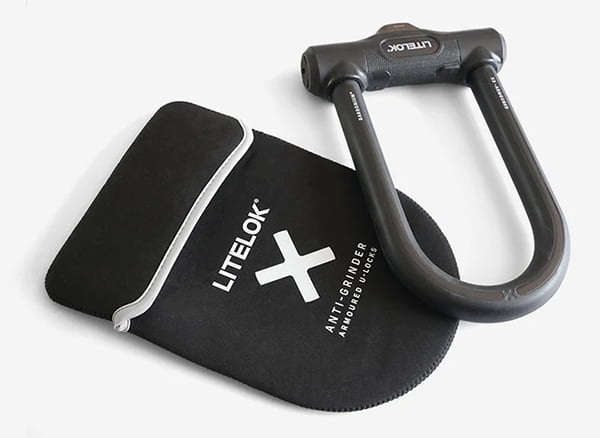
Litelok X1 pouch
For the Hiplok D1000, there is the plastic BR1000 mount. By itself, it only works on a pannier rack, though. Once you’ve attached it to your paneer rack, you clip the D1000 (or the DX1000) into the top and secure it with a rubber strap.
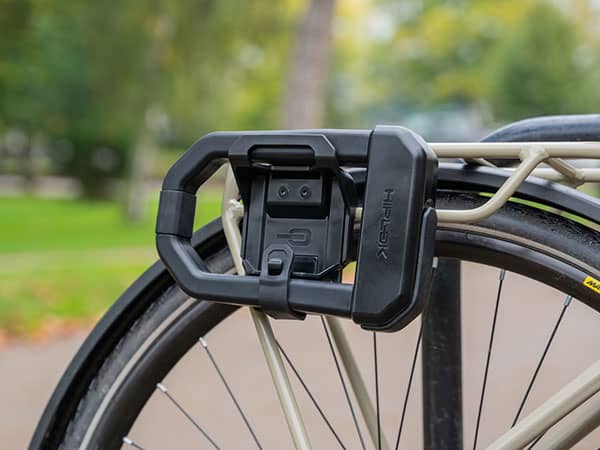
Hiplok BR1000 on pannier rack
If you want to attach your D1000 anywhere else on your bike frame, you will need to buy a third party adapter.
There are two brands of third party adapters that work with the BR1000. And you’ll need a different model depending on where on your frame you want to attach the lock (handlebars, frame tube or seat post).
I tested the KlickFix handlebar adapter [Amazon], and it worked pretty well: I quite liked carrying the Hiplok D1000 on my handlebars rather than the frame as I normally would.

KlickFix adapter with BR1000 & D1000
However, since the BR1000 just clips in and out of the KlickFix, there is a chance it will be stolen if you leave it when you lock up your bike. Which means you end up carrying the BR1000 around with you (or worrying that it might be stolen).

Hiplok D1000 carry pouch on my hip
Hiplok also sell a Carry Pouch that can either be worn on your belt (like the Litelok Restrap Holster), or strapped to your frame. Although it’s more luxurious, I had the same issues with the pouch as I did with the Litelok holster (it’s fiddly to use and uncomfortable).
However, the Hiplok Carry Pouch can also be strapped to your bike frame, handlebars or pannier rack. It was too long for my handlebars but worked really well on the frame, being simple to use and very stable.

Hiplok D1000 carry pouch on my bike
Unfortunately, since it is only attached to your frame with Velcro straps, you have the same issue as the BR1000 when used with a third party adapter: it can easily be removed and stolen. So you may feel compelled to take it with you when you’ve locked your bike, which is a bit inconvenient.
By the way: the transport options for the Hiplok D1000 and DX1000 (specifically related to the B1000), can get pretty complicated, so I have written a whole post on them, to explain my experiences in more detail.
For me, the Litelok Tactical Mount is probably the best option overall. But if I had a pannier rack, I would undoubtably prefer the Hiplok BR1000.
The third-party adapter scenario with the Hiplok BR1000 just feels overcomplicated to me, unfortunately.
As ever, it’s going to depend on your personal circumstances, but it’s nice to see that both locks now provide a variety of transport options!
Which lock is easier to fasten around a bike, Hiplok D1000 or Litelok X1?
This will very much depend on the type of bike you ride and where you habitually lock it up. And it’s related to the internal measurements of the locks…
The Litelok X1 measures 3.97" (10.1 cm) wide and 7.7" (19.6 cm) long, which makes it more or less the same size as a standard size u-lock such as the Kryptonite New York Standard (it’s the same width, but about 1.5 cm shorter).

The Hiplok D1000 measures 3.62" (9.2 cm) wide and 6.1" (15.5 cm) long, which makes its internal measurements more like a mini u-lock (although the bulk of the rest of the lock makes it much bigger overall).

In fact, the Hiplok D1000’s dimensions and weight make it very much like the Kryptonite Fahgettaboudit New York Mini.
The smaller your bike lock’s internal measurements, the more difficult it will be to get around your bike and whatever you’re trying to lock it to.
When I tested these two locks on my skinny hipster bike, there was no difference when locking it to an empty Sheffield stand bike rack; every way I locked it with the Litelok, I could lock it with the Hiplok.

However, it was tighter with the Hiplok, and in a busy bike stand, that would make it more difficult. And if I was locking any other type of bike (other than a skinny wheeled, skinny framed city or road bike), I might have to compromise the way I locked the bike.

For example, with many bikes, you won’t be able to get the Hiplok around the frame and rear wheel and the immovable object. Now, although this is accepted best practice on how to lock your bike, it’s certainly not the only way.
It’s perfectly acceptable to just lock the frame to the immovable object and use other ways to protect your wheel.
However, as a side note: don’t be tempted to just lock the top tube to the rack. As locks get more resistant to angle grinder attacks, thieves will just start cutting through the racks. So make sure you lock the bike in a way that will at least stop them riding the bike, without cutting the lock too.

So the bottom line is: if you ride a skinny (frame and wheel) bike in a city, you should be fine with either the Hiplok D1000 or the Litelok X1. If you ride a bigger bike, or don’t use bike racks, you may have to adapt your locking technique if you want to use the Hiplok D1000.
And it may still be frustratingly difficult.
My advice here is: consider the places you lock your bike and the techniques you want to use, and choose or adapt accordingly.
Litelok X1 vs Hiplok D1000: Which is the best value for money?
Both the Litelok X1 and the Hiplok X1 are expensive, compared to any other high security bike lock.
However, while the Litelok X1 is moderately more expensive (coming in around $180 or £150), the Hiplok D1000 is eye-wateringly more expensive (retailing at around $300 or £250, check price on here).
The extra expense of the Hiplok may be because it’s based on someone else's technology (Ferosafe was developed by a company called Tenmat and Hiplok will presumably have to pay them extra to use it). Or it may be because of the extra material used (there is more metal in the Hiplok).
And of course the Hiplok D1000 is significantly more secure, so the price is certainly justified in that respect.
But $300 is more than my bike cost!
And the question everyone needs to ask themselves is: just how much angle grinder resistance do I need to protect my bike?
Because the best value lock will be the one that provides sufficient protection for the lowest price.
How much time and how many discs is enough?
A thief is going to need to change angle grinders at least once to defeat either lock. And depending on the power of the angle grinder and how much the lock moves around, that could be several discs, even in the case of the Litelok X1.
Hiplok D1000 vs Litelok X1: Conclusion
So while these are the first two angle grinder resistant bike locks to come to market, they’re actually very different.
If you decide that you need the very highest level of angle grinder resistance, then the Hiplok D1000 is the one to go for. You just need to make sure it’s big enough to use on your bike, and also think about how you’re going to carry it around.
If you decide that a moderate level of angle grinder resistance is enough, then the significantly lower price, easy portability and generous internal dimensions of the Litelok X1 will be the better choice.
For a lot of people, I think the Litelok X1 will be the more sensible option, which is why I’ve made it the best bike lock in 2025!
But as ever, it will depend on your own individual circumstances.
Alternatives to the Litelok X1 and the Hiplok D1000
If you’re not happy with the compromises, you have to make with both the Litelok X1 and the Hiplok D1000, then there is one worthwhile alternative.
In my tests, the Litelok X3 was as secure as the Hiplok D1000, but has the same dimensions as the Litelok X1.

Litelok X1 vs Litelok X3 vs Hiplok D1000
Unfortunately, there’s no frame mount (it’s just too heavy). So you'll have to use their belt strap or your own bag to carry it around. And at around $350 or £280 it’s a bit more expensive than the Hiplok D1000.
But if your main issues are with the Litelok X1’s reduced security and the Hiplok D1000’s smaller locking circumference, then the Litelok X3 addresses both those issues, and is definitely worth looking at.
They actually have a special offer for pre-orders at the moment, where it’s the same price as the Hiplok D1000, so check it out now!


Great article and thanks for taking the time. I have bought my last two locks (lost one drunk!) based on your reviews and shall do my next purchase based on the same.
Just need to ask for a favour please. Could you wear better gloves and proper boots when going for it with angle grinders!
Cheers from NZ!
Carl, ran across your blog as a new bike owner and just getting into biking. My dad passed away and I inherited his top-shelf, worth-more-than-my-life fat bike. Thanks for your article. Im learning a lot about bike safety and fat tire bikes provide a unique challenge to keeping them from getting stolen. I went with Hiplok D1000 for the frame and a Fahgettaboudit NY chain for the tires. 20 lbs of weight to carry a lot maybe? Nah, Id carry 50lbs if I had to for peace of mind when it comes to this bike. Cheers from USA mate,
Nice! Just remember to try to ensure that the thing you’re locking your bike to is as secure as the locks you’re using.
Sure thing, noted. Thanks for your response
Great article, I even subscribed on YT
Hiplock or Litelock 1? Hard choice… I ended up ordering both. ( I have a Giant E -bike and a Trek F3 hybrid, both well worth protecting.)
A very useful review and I think I will probably go for the lightlock x1 where I may have previously gone with the hiplock just because of practicality of use- thanks
I have the D1000. It’s awesome. Love that I don’t have to worry about someone cutting and stealing my bike. But, wish I would have gone with the X3. I thought the slight size difference would be insignificant, but the D1000 is just small. It means I never get to lock a wheel. And sometimes have a hard time even locking the frame. I also got the D1000 transport case, thinking I’d be able to strap it to my bike or my hip but totally not realistic. So heavy. And, I worry about the bare plastic clips wearing on my carbon frame. So, it goes in a backpack anyway.
It’s just Velcro straps on the D1000 transport case, isn’t it Evan? I wouldn’t have thought they could damage a carbon frame…
The locks may withstand the grinder, but couldn’t the thief easily cut the object that the lock is attached to?
Yep, it’s certainly possible, in some cases, Ray.
That’s why when you lock it also needs to go through a part of the bike that makes it un rideable not just the frame to the object.
Than they will need to cut through the lock.
Why aren’t these recommended on this page?: https://thebestbikelock.com/best-u-lock/
I just haven’t updated that page yet!
Great review. Edging towards the litelok now, cheers.
Reading the bio; what was the single best thing you did to stop the bike theft rot?
Hi Lloyd,
I think it’s the simple realization that you have got to find the right lock for your personal circumstances.
I live in a city where there is a lot of bike theft, but it is not very sophisticated (not much, if any, angle grinder use).
I ride a pretty low value bike, but I leave it in the street, overnight, every night.
If I use a cable lock (as I did in the past), the bike will be stolen immediately. But I don’t need an angle grinder resistant lock.
A simple Gold rated u-lock is enough.
So it’s about finding that balance.
Thanks!
Carl
Bonsoir, ma question étant, les antivols présentés sont plus fiable à la découpe d’une disqueuse, que d’autres antivol et du coup sont t’ils plus vulnérable à une pince monseigneur,(coupe boulon),que d’autres antivol,style Abus granit x-plus 540.
No, they are still very resistant to bolt cutters as well.
Thank you! This article is sanity-inducing, was willing to spend up to $200 so this answers the question perfectly!
How is the X1 secured to the frame? You mentioned the danger of being stolen with a fabric holder to the frame, but it looks vulnerable to being stolen with the frame mount included. I guess it’s less attractive to thieves given you’d have to be a registered owner to have keys made.
Personally, beyond the cost, I wouldn’t even consider the D1000. I have an ebike, and trusting there’d always be a suitable something to chain it to seems ridiculous, it’s just too small.
I’ve cancelled ebike trips cause I refuse to have my bike stolen! Took me 6 months of scrimping to afford it!. So hopefully I’ll be able to swing an X1 this next month.
I’ve got a Kryptonite with about 9.5” inner length which is a luxury. I’d probably use that one for quick trips, and the X1 for less guarded locations, or maybe both.
I wish there were sales on these- we’re coming up on Black Friday and on the web I only found a modest discount if you bought 2 of them. Any suggestions?
Thanks again, you really did a knockout job on this article- everything from the illustrations to the info and summary! I enjoy making my writing as concise and informative as possible, you’ve achieved that here!
I use a D1000 on my Niner RIP e9. No problems at all.