

The Hiplok D1000 and Litelok X3 are probably the two most secure bike locks you can buy at the moment. And this is down to their extreme angle grinder resistance.
But which is the most angle grinder resistant? Which is the easiest to use? And which is the best value for money?
That’s what we’re going to find out today…
The Litelok X3 gives you the most locking options. The Hiplok D1000 has the most carrying options. Security is almost equal!
Summary
 |  |
|---|---|
Width: 3.93" (10 cm) | Width: 3.62" (9.2 cm) |
Length: 7.6" (19.5 cm) | Length: 6.1" (15.5 cm) |
4.6 lb (2.1 kg) | 4.2 lb (1.9 kg) |
Security: 5/5 | Security: 5/5 |
Practicality: 4/5 | Practicality: 4/5 |
Hiplok D1000 vs Litelok X3: Which is most secure?
Both locks have exactly the same ratings from Sold Secure and ART (the independent security testing organizations). So that’s a Pedal and Powered Diamond rating from Sold Secure. And 4 out of 5 stars from ART.
And this places them in a small, elite group of bike locks.

Litelok X3 shackle: 16 mm
They both have the standard double locking shackles you’d expect from any high security u-lock. In the Litelok’s case, it’s a circular 16 mm profile shackle. In the Hiplok’s case, it’s a 20 x 15 mm square profile shackle.

Hiplok shackle: 20 x 15 cm
This means they’re both highly resistant to leverage attacks, and neither can be cropped by manually operated bolt croppers of any size.
In fact, the only way that either can be defeated is with power tools. And these days, in the street, that means angle grinders.
So which provides the most angle grinder resistance?
I used a mains powered angle grinder to cut both locks while they were held tightly in place by tape. This is obviously not the way they would be attacked in the street, where a thief would use a battery powered angle grinder, and would find it very difficult to keep the locks from moving around.
But I was trying to find out which lock has the most inherent angle grinder resistance. So I wanted to eliminate any outside variance (different movement in the locks, different battery levels), that might skew the test.
Here are the results (with the time it took to cut the Kryptonite Fahgettaboudit Mini added for comparison to a regular lock):
Time to cut | Kryptonite | Litelok X3 | Hiplok D1000 |
|---|---|---|---|
First side: | 16 seconds | 3:25 min | 2:50 min |
Both sides: | 32 seconds | 5:30 min 4 discs | 4:25 min |
In summary:
- Fahgettaboudit: I only needed 1 disc to go through both sides in a total of 32 seconds
- Hiplok D1000: it took 4:25 min to go through both sides and I used 5 discs in total
- Litelok X3: it took 5:30 min to go through both sides and I used 4 discs in total
So, the Litelok X3 took nearly 1 minute longer to cut through, but the Hiplok D1000 required more discs.
Bear in mind that these numbers don’t include the time it took to change the angle grinder discs. If they did, not only would all the total times be much longer, but the difference between the Litelok and the Hiplok would be significantly less (due to the extra disc change for the Hiplok).
To give you an idea of how much longer it might take a thief in the street, when I tested the Litelok X1, I didn’t do a very good job of anchoring the lock, so it kept moving around when I was trying to cut it, which wore out the discs much faster.

I couldn't cut the other side of Litelok X1 as it moved around too much
In the end, I used up all the discs I had before I cut the second side! And the X1 is much less secure than the X3 or the D1000.
But getting back to this comparison, which of the two is more secure?
From this particular test, it looks like the Litelok X3 is a little bit more angle grinder resistant than the D1000.
But if I did the test again, I wouldn’t be surprised if the result was reversed, because they were so close this time, and despite my best attempts, there will always be outside variables affecting the results.

Litelok X3 Abloy cylinder is more secure than Hiplok's
It is worth noting that the Litelok X3 features a much more secure (Abloy Sentry), lock cylinder than the bog-standard mechanism on the Hiplok D1000. But since bike thieves don’t pick locks, it’s not hugely important.
So in conclusion: they are both extremely secure bike locks, they both have extremely high levels of angle grinder resistance, and I'd say that any difference between them is probably insignificant when trying to choose between them.
What you should be thinking about instead, is usability and price…
Hiplok D1000 vs Litelok X3: Which is easiest to use?
Let’s take a look at how easy these locks are to carry around while you’re riding, and how easy they are to secure your bike with, when you get where you’re going.
Which lock is easier to carry around, Hiplok D1000 or Litelok X3?
Both of these locks are very heavy.
The Litelok X3 weighs 4.6 lb (2.1 kg), which is about the same weight as 5.5 cans of Coke. And the Hiplok D1000 weighs 4.2 lb (1.9 kg), which is just over the same weight as 5 cans of Coke.

So the Hiplok is slightly lighter.

It’s worth noting, that although heavy, they are both lighter than many regular, high security bike locks, all of which they massively outperform security wise (e.g. the Abus Granit Extreme 59 and the Kryptonite New York Fahgettaboudit Mini).
But still, 5 cans of coke is a lot of weight to be carrying around on your bike every day.
Luckily, there are a whole selection of transport options for both of these bike locks.
Litelok X3 Carrying Options
For the Litelok X3, the best option is probably their Tactical Mount. This is a tough plastic mount that you can strap to your frame (or even your seat post). And it’s relatively straightforward to install with an Allen key and a pair of scissors.

Litelok X3 in the Tactical Mount
To use it, you push the shackle through a hole in the mount, lock the crossbar to the shackle and then twist and click the lock into place. So the X3 is actually locked into the frame mount for extra piece of mind.
Getting the lock into and out of the mount smoothly takes some practice. The mount has to be really tightly strapped to your frame to avoid any movement, and it works best if you’re able to push the lock downwards through the hole.
The lock is really well-supported once inside the mount, though, and I noticed no movement or noise as I rode about. The combination of the lock and mount is quite a bulky though, so make sure you have enough space on your frame.
If you don’t fancy the frame mount, then there are other options for the Litelok X3.
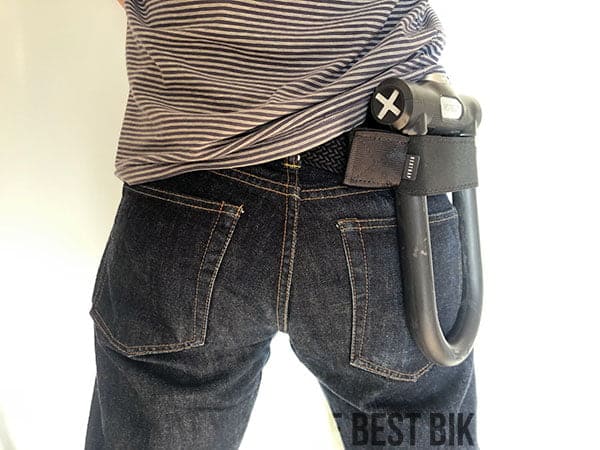
Litelok X3 Restrap Lock Holster
There is also a Restrap Holster which is a fabric strap that you thread your trouser belt through. This allows you to carry the Litelok X3 on your hip. I found it a bit uncomfortable (because of the lock's weight) and quite fiddly to use.
But it does work, and it’s a bit cheaper than the Tactical Mount, so it may work better for you.
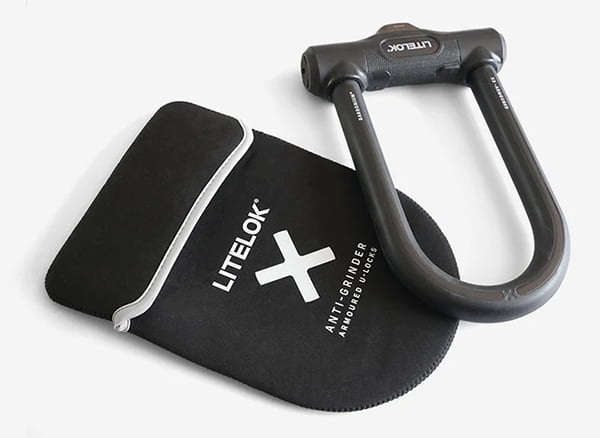
Litelok X3 pouch (can't be worn or strapped to your bike)
And lastly, there is the neoprene pouch, that comes with the Litelok X. The fit is nice and snug and the lock slips in and out very easily. But it’s really just a cover to stop the lock making the inside of whatever bag you're using wet or dirty.
Hiplok Carrying Options
For the Hiplok D1000, the best option is the BR1000 Frame Bracket. This is a smallish plastic mount that can be attached directly to your pannier rack. Once installed, you clip the D1000 into the top, horizontally, and then secure the bottom with a rubber strap.
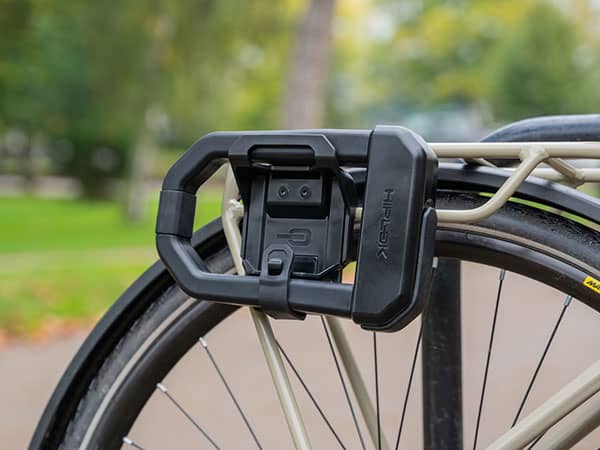
Hiplok BR1000 on pannier rack
The weird thing about this mount is that out of the box, it only works with a pannier rack. If you don’t have a pannier rack (and I don’t), you need to buy a separate third party adaptor to use it elsewhere on your frame.
So I got a KlickFix handlebar adaptor [Amazon]. This attaches to my handlebars. The BR1000 Frame Bracket then attaches to the KlickFix handlebar adaptor. And then the Hiplok D1000 lock clips into the BR1000 Frame Bracket!

With the adaptor, I could carry the Hiplok D1000 on my handlebars
It’s a bit convoluted but it works well once it’s all set up (everything is very stable), and I quite like carrying my bike lock on the handlebars (rather than elsewhere on the frame).
Hiplok also sell a carry pouch that can either be worn on your belt (like the Litelok Restrap Holster) or strapped to your frame. Again, I wasn’t so keen about it on my belt (for the same reasons), but it worked well on my bike frame.

The carry pouch can be carried on your belt or your bike!
The only problem is that it’s attached to the frame with Velcro straps, so to avoid it being nicked you probably have to unstrap it and take it with you when you’ve locked your bike up, which isn’t super convenient.
I have written a whole post on the frame mount options for the Hiplok D1000 (and DX1000), so I won’t go into any more detail here.
So which is the easiest to carry?
I think the Litelok Tactical Mount is probably the most straightforward option here, so as long as your bike can accommodate it, the Litelok has the best frame mount.
However, the Hiplok has the best mount for pannier racks (Litelok doesn't really have an option here). Plus, the Hiplok D1000 is smaller and lighter than the Litelok, so will be easier to carry in a bag.
So it's a tie: it really depends on your set-up and how you'd prefer to carry your bike lock!
Which lock is easier to fasten around a bike, Hiplok D1000 or Litelok X3?
It’s probably going to be easier to lock your bike with the Litelok X3, simply because it’s wider and longer.
The internal measurements of the Litelok X3 are 3.9 x 7.6" (10 x 19.5 cm), making it similar to a standard size u-lock, such as the Kryptonite Kryptolok or Evolution Standard (it’s actually the same width, but 1.4" shorter).

Litelok X3 internal dimensions
In contrast, the internal measurements of the Hiplok D1000 are 3.62 x 6.1" (9.2 x 15.5 cm), making it similar to a mini u-lock such as the Kryptonite Fahgettaboudit New York Mini (it’s just ever so slightly wider).

Hiplok D1000 internal dimensions
This means it will generally be easier to get the Litelok round your bike and whatever you’re trying to lock it to.
I ride a skinny framed bike with slim wheels in a city where there are loads of Sheffield style bike stands. And any way I used the Litelok X3, I could also use the Hiplok D1000 too.

Lots of room in side the Litelok X1
It might have been a bit more fiddly and a tighter fit, but I always managed...

Much tighter fit with the Hiplok D1000
But for those with bulky mountain bikes or sturdy ebikes, it could well be a different story. And it may even be that they can’t lock their bike how they’d like with the Hiplok D1000. There will usually be a different way to lock a bike, but that may mean some compromise.
For example, it could be that the Hiplok D1000 won’t be able to secure your wheel and your frame together, so you just use the u-lock to secure the frame, and an additional lock to secure the wheel.
Or there are other options for wheels.
It’s all going to depend on your personal set-up. But there’s no doubt that the Litelok X3 is going to be more suitable for bulkier bikes.
Litelok X3 vs Hiplok D1000: Which is the best value for money?
The Hiplok D1000 and the Litelok X3 are usually exactly the same price. To be sure, check the Hiplok D1000 price here and the Litelok X3 price here.
Since they both offer more or less the same level of security too (and obviously this is by far the most important aspect of any bike lock), it’s hard to say that one offers better value for money than another.
But let’s look at the distinct advantages and disadvantages of each:
Litelok X3 Advantages & Disadvantages
Hiplok D1000 Advantages & Disadvantages
The most significant difference between the two locks is probably the internal locking space. If you’ve got a bulkier bike, then you’re probably going to appreciate the extra space inside the Litelok X3.
If locking options are less of an issue, then you might appreciate the smaller and lighter Hiplok D1000.
But despite the expense, if you consider the massive gulf in security between these two locks and every other bike lock on the market (except the Litelok X1, which I cover below), they are both great value for money!
Litelok X3 vs Hiplok D1000: Conclusion
The Hiplok D1000 and the Litelok X3 are by far and away the most secure bike locks you can currently buy. And if you need maximum angle grinder resistance, these are the bike locks for you!
But if you’re trying to choose between them, then you need to look beyond security level, because they’re both more or less equal in that respect.
Instead, think about whether you prioritize ease of locking or ease of transport.
The Litelok X3 is longer and wider, so it’s going to be easier to lock your bike with. However, that extra size, means it’s bulkier and slightly heavier, which makes it more difficult to carry around.
The Hiplok D1000 is much smaller, so you might struggle to lock your bike, especially heavy ebikes and city bikes. However, this makes it lighter and less bulky and therefore a bit easier to carry around.
There are a selection of different accessories that could help you carry both locks around. Litelok has the best frame mount. But Hiplok has a wider variety of options here. It's worth thinking about which works best with your particular set-up.
Of course, if neither compromise is acceptable, or you just can’t justify the price of these locks then there is an alternative…
Alternatives to the Litelok X3 and the Hiplok D1000
The Litelok X1 seems to have the all the advantages of both the Litelok X3 and the Hiplok D1000 (plus a few extra of its own), with hardly any of the disadvantages.

Litelok X1 vs Litelok X3 vs Hiplok D1000
It has the same dimensions as the X3, so it will be easy to secure your bike in loads of different ways. But it’s lighter than both the X3 and the D1000, and comes with its own frame mount, so carrying it around on your bike is straightforward.
It has the same Pedal and Powered Diamond ratings from Sold Secure. And the same 4 stars from ART.
It’s also much cheaper than the Litelok X3 and the Hiplok D1000.
So what’s the catch?
Well, although it has the same independent security ratings as the Litelok X3 and the Hiplok D1000, it doesn’t have quite the same level of angle grinder resistance as these locks. In my tests, it took me significantly less time (and fewer discs) to cut the Litelok X1.
But it still took me far more time than any other high security bike lock. And even a thief with better angle grinder skills than me is going to have to change discs to get through it. Which is a big deal in the street.
My feeling is that for most cyclists, the Litelok X1 provides the best balance between security and practicality, which is why I made it my best bike lock for 2023 (the first time it’s not been the legendary Abus Granit X Plus 540 since I started this website).


Do either of these companies offer replacement shackles if an angle grinder attack damages but does not breach the lock?
Litelok X3 was delivered in 2 weeks when I ordered one recently. It’s a sturdy piece of kit and has replaced my ageing Fahgettaboudit. Similar weight, easier to use (bigger D), nice neoprene bag. Only downside for me was the price but it’s worth it for when I have to lock up outside my work.
Good review! I now have all three, as I have several bikes to protect. The X1 is used as a carry along-lock, and the two heavier ones are stationary where I lock my bikes to a very solid steel structure outside my appartment building. This structure probably is the weakest point in this chain, but it surely will take a lot of professional and determined effort to get away with any of my bikes from here.
I also supplement with some (little less grinder proof, yet formidable) U-locks from ABUS and Kryptonite, and a cable and a chain. I guess it looks funny, but I have had enough bikes stolen through the years. The thieves must hate me, hope they don´t respond by ruining my bikes… 🙂
That’s a lot of security Jorgen!
Hi Carl,
Both the Litelok X3 and the Hiplok D1000 show a very impressive performance against an angle grinder with an abrasive metal cutting disk. But what about bolt cutter ? or an angle grinder with a masonry disk ? masonry disk are commonly used to cut Titanium for example… or even a a freezing spray / hammer combination ?
Those locks use a ceramic based alloy which make them very hard and difficult to cut with an abrasive disk. But harder material means more brutal and therefore easier to break under shock.
Anybody tested that?
Hi,
Sold Secure test all these types of attacks (apart from possibly specialized angle grinder discs).
And they passed in the same way as the regular high security locks did, otherwise they wouldn’t have the rating they do.
Thanks!
I have both locks. Yeah these locks are expensive, but if you’re out and about in, and near ‘The City,’ by way of a cherished bike, a carbon fiber bike, or one of your ebikes, you understand. Though the Litelok X3 is a little more practical than the Hiplok D1000 due to its diameter, I’ve encountered unlocking issues with the X3. It seems that over time, the locking mechanism tends to get very frustrating to unlock, whatever you’ve lock. A good amount of banging is required for the X3 to disengage.
Well I find that somewhat unreliable.
Heck, one day it may not come off at all! Thus, I’ve refrain from using it.
Perhaps, my particular X3 is a defect. For this reason, I do not recommend the Litelok X3. They’re other angle grinder resistant ulocks on the market that you can choose to lock your bikes with.
Mmm interesting. It sounds like the problem might be where the shackle meets the body rather than the mechanism.
I had the same problem with my Litelok X1 but was able to fix it by trimming away some of the rubber shackle cover with a knife.
See https://thebestbikelock.com/best-bike-lock/how-to-stop-your-bike-lock-jamming/#t-1719987725755 for more details.
Please let us know if this was the issue and you were able to fix it with these steps!
Is the X3 proof against diamond edge angle grinder discs and also freeze sprays?
Freeze sprays yes.
A diamond disc will cut through them, but it takes a while, although not as long as regular discs, and you might not need to change discs.
In my next round of tests, I will be using diamond discs too.
i think u should use diamond disc at your first try ,, person who going to steal bike will use them straight away as common sense
No, at the moment they tend to use regular masonry discs as they are much cheaper and will cut 99% of locks very easily.