

Finding the best lock for your bicycle is tricky. There are loads to choose from. And the wrong decision can have disastrous consequences!
The secret to success is choosing a lock that’s both secure enough to protect your bike and easy enough to use on a daily basis.
As well as being within your budget!
This balance between strength, practicality, and price is essential, as far as I'm concerned. And I've been testing bike locks and writing about bicycle security since 2015, so I know what I'm talking about!
With that in mind, I recommend 6 of the best bike locks available today, based on their security level and my user tests.
But if none of them seem quite right for you, don’t worry! I also suggest some alternatives. And after these picks, I’ll show you the three simple steps (including a quick quiz to determine your risk level) that will guarantee you find the perfect bike lock for your needs.
1. Litelok X1
The best all-around bike lock in 2026 is still the Litelok X1. This is because the Litelok X1 is one of the few bike locks that offers any kind of protection against thieves wielding cordless angle grinders!
In many towns and cities, it feels like angle grinders are the most common method of stealing bikes that aren’t secured with flimsy cable locks. So if we’re serious about keeping our bicycles safe, we need a lock that offers some kind of resistance against these tools.
And in my opinion, the Litelok X1 provides the best balance between security, practicality, and price for those cyclists that require the higher level of protection offered by an angle grinder-resistant bike lock.

Litelok X1: the best all round bike lock
All the things I originally liked about the Litelok X1 still hold true in 2026:
- Exceptional security-to-price ratio
- Consistent build quality and angle grinder resistance
- Practical size and weight
- Several decent frame mount and carrying options
It’s not the most secure of these bike locks (check out my exhaustive tests to discover the most angle grinder-resistant bike lock). But it provides enough all-around security to thwart most street thieves for the least amount of money.

Litelok X1 | |
|---|---|
My score: |  |
Check price: | |
Shackle thickness: | 16 mm |
Weight: | 3.7 lb (1.7 kg) |
Size (internal): | 3.97 x 7.7" |
Other Security Ratings: |  |
Most importantly: in my most recent tests, it proved impossible to defeat the Litelok X1 without changing multiple angle grinder discs, which is going to prevent your bike from being stolen in the vast majority of cases.

Watch my angle grinder test of the Litelok X1
We do need to talk about the current price, though.
If you’re in the USA, then the prices of almost all the angle grinder-resistant locks have gone through the roof in the last year, and Litelok's prices seem to have been particularly affected (perhaps because they are manufactured in the UK).
If you’re in the UK or the EU, then the prices have been more stable, and I have no hesitation in recommending the Litelok X1 as the best bike lock currently available for those that need a high security option (unless you need the very highest protection).
However, since the cost of the Litelok X1 may now be out of reach for many US readers, we need to consider some alternatives…
SkunkLock Carbon?
The only anti-angle grinder bike lock that is the same price in 2026 as it was in 2025 is the SkunkLock Carbon. Which makes it (by far) the cheapest option at the moment (check Amazon price).
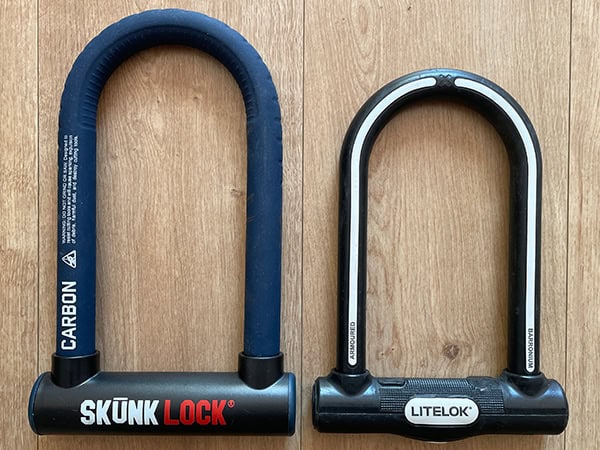
SkunkLock Carbon vs Litelok X1
The best thing about the SkunkLock Carbon is its resistance to a conventional angle grinder attack, which has been exceptional in my tests.
However, there are several reasons I am reticent about recommending it over the Litelok X1:
- Much bulkier and heavier than the Litelok X1, with no option of a frame mount.
- Not the greatest build quality
- Poor performance against diamond discs
- Vulnerable to less conventional attacks
- Not tested and rated by Sold Secure

SkunkLock Carbon after cutting
For me, the SkunkLock Carbon might be a good choice for price-conscious e-bike (or other bulky bike) owners, where its size (it has the biggest locking area of all the anti-grinder bike locks) could be a real benefit.
Personally, I think the SkunkLock Carbon will just be too big and bulky for most cyclists. However, if you’re looking for an angle grinder-resistant bike lock at a bargain price, this is the one to go for!
OnGuard RockSolid?
Another relatively low-priced option is the OnGuard RockSolid, although, at the time of writing, it’s actually slightly more expensive in the US than the Litelok X1 (check Amazon price here)!
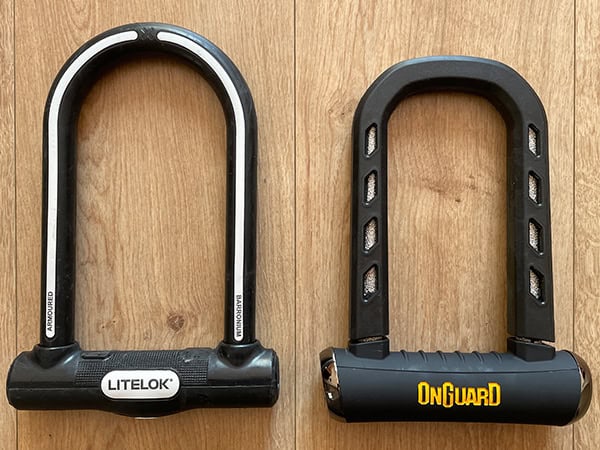
Litelok X1 vs OnGuard RockSolid
Again, the OnGuard RockSolid performed very well in my angle grinder tests. However, once again there are a few reasons I don’t recommend it over the Litelok X1:
- Inconsistent angle grinder resistance: it has performed very poorly in other people's tests
- I was able to pry open a significant gap in the shackle after just 1 cut
- No frame mount option
- May be too small for many cyclists
- It’s more or less the same price as the Litelok X1

OnGuard RockSolid: big gap after one cut
OnGuard prices do vary considerably, though, and if you shop around, you can often get big discounts. If you can find it significantly cheaper than the Litelok X1, then it’s a great alternative.
I appreciate that both SkunkLock and OnGuard are still very expensive, so what are the other options?
Other Options
If you want high security but can't afford anti-angle grinder prices, then the popular Kryptonite Evolution Mini-7 or the slightly bigger and more secure Kryptonite Evolution Standard New-U are potential alternatives.
And when you check the prices, they will seem like a bargain compared to the anti-angle grinder locks!

Kryptonite Evolution Mini-7
Both of these locks are very secure and are unlikely to be defeated by anything but an angle grinder attack. However, have no doubt: if they are attacked by an angle grinder, they will be defeated in seconds.
And unfortunately, the same goes for every other bike lock that isn’t on the list of angle grinder-resistant bike locks.
So, if you feel you need to protect your bike from thieves with angle grinders, I still think the Litelok X1 will still be the best option for the majority of cyclists.
Of course, if you ride a very expensive ebike, where you need the very best protection and the weight and the bulk of your lock are less important, you should probably be looking at even stronger (and even more expensive) bike locks!
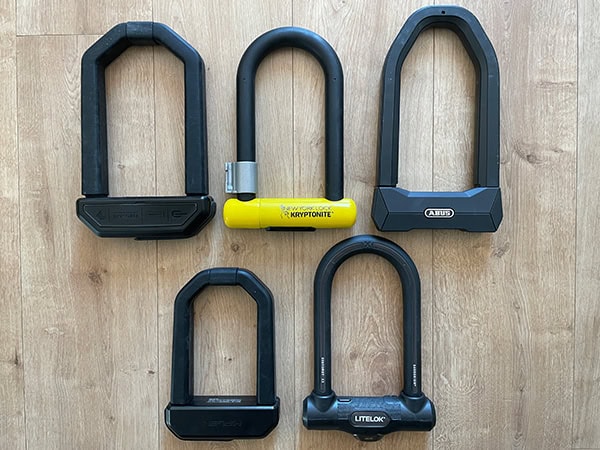
More secure and much more expensive than the Litelok X1
For more details on my tests and the strengths and weaknesses of these locks, check out my full guide to angle grinder resistant bike locks.
2. Kryptonite Kryptolok New-U
Not everyone needs an angle grinder-resistant bike lock! And I urge you again: take my quick 3-question quiz to determine your risk level and help you decide whether you do need one or not!
And for those that don’t, the Kryptonite Kryptolok New-U (which is an upgraded version of the famous Kryptolok Series 2) is still a great, inexpensive alternative.

Kryptonite Kryptolok Standard: best medium security bike lock
By improving the shackle so that it locks on both sides rather than just one, Kryptolok has raised its Sold Secure rating from Silver to Pedal Cycle Gold. However, the fact that it keeps its 2/5 rating from ART means it remains very much a medium-security lock.
The best thing about the Kryptolok, though, is that it's a great all-rounder...
It's quite light (weighing about the same as 3.5 cans of Coke). And if you attach the frame mount correctly, it's easy to carry while you're riding around.
The generous size means you won't struggle to find places (or ways) to secure your bike when you get where you're going. And it’s usually available with a supplementary cable lasso to help protect your wheels.

Kryptonite Kryptolok New U | |
|---|---|
My score: |  |
Check price: | |
Shackle thickness: | 12.7 mm |
Weight: | 2.9 lb (1.32 kg) |
Size (internal): | 4 x 9" (10.2 x 22.9 cm) |
Kryptonite rating: | 6/10 |
Other Security Ratings: |  |
To be honest, I do prefer the keyhole covers and slider keys you get with OnGuard locks, which are easier to use and seem to eliminate disc misalignment. But there isn’t an OnGuard equivalent of the Kryptonite Kryptolok New-U.
And if you really don’t like the key system that comes with the Kryptolok, then you could always go for the KryptoLok Combo [Amazon], which doesn’t use keys at all! It is essentially the same lock, with the same security ratings. But it uses a 4-digit code to lock and unlock rather than a key.
Also, Kryptonite's customer service is undoubtedly the best of all the bike lock brands. This means a whole load of benefits, from free keys to reduced price (or even free) lock replacements in some circumstances.
If you want a Kryptonite lock that's more secure, then you should take a look at the Evolution range I mention above. But those locks will be heavier or smaller. And they still won’t stand up to an angle grinder attack!
However, if your circumstances are lower risk, then the Kryptonite Kryptolok will provide you with an easy-to-use bike lock and adequate protection for most circumstances (if you use a proper locking technique) for a very reasonable price.
Read my full, hands-on review of the Kryptonite Kryptolok, which includes the best alternatives if it’s not right for you.
3. Foldylock Compact
Folding locks are generally easier to carry and offer more locking opportunities than u-locks. However, choice is more limited, and most of them are simply not secure enough to recommend.
There are definitely some folding bike locks that are worth considering, though...
The Foldylock Compact is the lightest folding lock that still offers a reasonable level of protection. A Sold Secure Silver rating means it’s not a lock for high-risk circumstances, but if used correctly, it will be sufficient for many cyclists (take my quiz to find out if it’s suitable for you).

Foldylock Compact: lightest folding bike lock
What’s more, of all the folding locks I’ve tested, it’s also the easiest to use.
The Foldylock Compact is 33″ (85 cm) long, which means it has around the same amount of internal locking space as a standard-sized u-lock.
But because it’s flexible, it should actually give you loads more options when you’re looking for somewhere to lock your bike.
At 2.2 lb (1 kg), it doesn't weigh much more than 2.5 cans of Coke. And if you want something even lighter, there is a slightly shorter (75 cm) version, which is also available with a belt clip, so you don’t have to bother with a frame mount at all!

Foldylock Compact | |
|---|---|
My score: | |
Check price: | |
Plate thickness: | 5 mm |
Weight: | 2.2 lb (1 kg) |
Length: | 33" (85 cm) |
Foldylock rating: | 14/18 |
Other Security Ratings: |  |
Compared to the Abus Bordo 6000 (which was its nearest rival until the Abus was demoted from a Sold Secure Silver to a Bronze rating), the Foldylock Compact is lighter and much easier to use...
It’s easier to unlock, easier to unfold, easier to get around your bike, and comes with a better frame mount. Plus, it’s usually cheaper! Check the Amazon price for the most up-to-date deals.
So, if your circumstances are lower risk, and you’re looking for a compact, flexible, and lightweight alternative to a u-lock, this is a great choice.
Read my hands-on review of the Foldylock Compact, where I also suggest some alternatives if it's not the right bike lock for you. Or check out more of the best lightweight bike locks.
4. Foldylock Forever
Foldylock also offers a high-security folding lock called the Foldylock Forever, which is basically a beefed-up, heavy-duty version of their standard folding locks (the Classic, Compact, Mini, etc.).

Foldylock Forever. You won't get a u-lock around a traffic light!
Measuring 35.4" (90 cm), it’s slightly longer than the Foldylock Compact, which will give you even more locking opportunities (in the photo above, it easily fits around a traffic light, which would be impossible with a u-lock).
And if you ride a particularly chunky ebike, or you need to secure two big bikes at once, there is even a longer 43.3" (110 cm) version they are calling the Foldylock Elite [Amazon]. Just be aware it’s a fair bit heavier too.
More significantly, the arms of the Foldylock Forever are 6.5 mm thick (as opposed to 5 mm thick on their standard folding locks). This extra 1.5 mm helps give it a Sold Secure Pedal Cycle Gold rating (rather than Silver for the other Foldylocks).
The Foldylock Forever arms are also 1 mm thicker than all the other Sold Secure Gold rated folding locks (including the Abus Bordo 6500, the Trelock FS 500 Toro, and the Kryptonite Evolution 790).
This extra thickness is complimented by patented rivet protection to deter an attack by nut splitters. Although this type of attack is unlikely in the street, it is a known weakness of locks like the Abus Bordo 6500.
These extra security features mean that the Foldylock Forever is also the only folding lock to be awarded 3/5 stars from ART.

Foldylock Forever | |
|---|---|
My score: | |
Check price: | |
Plate thickness: | 6.5 mm |
Weight: | 3.88 lb (1.76 kg) |
Length: | 35.4" (90 cm) |
Foldylock rating: | 18/18 |
Other Security Ratings: | |
All in all, this makes the Foldylock Forever the most secure folding lock currently available, and it's the only folding lock that is secure enough for mopeds and scooters as well as bicycles!
Indeed, in my tests, I was unable to crop the Foldylock Forever, even with a ridiculously big set of 42” bolt cutters, and I think the only way this lock is likely to be defeated in the street is with a portable angle grinder.
The high security level comes at a cost in weight, though. At 3.88 lb (1.76 kg), it’s a heavy lock, weighing slightly more than 4.5 cans of Coke.
However, like all Foldylocks, it excels in terms of usability. It’s easy to unlock, smooth to unfold and refold, and you get a more internal locking space than a standard size u-lock, which means loads of locking opportunities.
And although I’ve read some reviews that suggest that the lock sits either too tightly or too loosely in the mount, I found neither. Just like the Classic, the Forever slides in and out of my plastic mount very smoothly but sits very snugly and safely while in there, with no rattling as you’re cycling around.
Moreover, although it’s not cheap, if you check the prices [Amazon], it’s usually cheaper than the Abus Bordo 6500 and the other high-security folding locks.
Read my full, hands-on Foldylock Forever review for more details. Or read more about folding locks here.
5. Kryptonite Kryptolok 955 Mini
For those looking for a more traditional bike lock, the Kryptonite Kryptolok Series 2 955 Mini is a short chain lock designed for mobile security in relatively low-risk circumstances.

Kryptonite Kryptolok 955 Mini: best medium security chain lock
When locked, it has slightly less internal space than a standard u-lock. But because it's flexible, it provides you with loads more places you can lock your bike.
Like all chains, it's much heavier than u-locks which provide a similar level of security (it weighs about the same as 4.5 cans of Coke). But it's still light and short enough to carry wrapped around your seat post or thrown in a bag.
And when it comes to actually locking your bike up, the integrated locking mechanism makes the whole process much smoother than using the separate padlock you get with most other chains.
With 9 mm links, it’s not the most secure bike lock, but it is rated Sold Secure Pedal Cycle Gold, and it offers far more protection than any cable lock.

KryptoLok Series 2 955 Mini | |
|---|---|
My score: |  |
Check price: | |
Chain thickness: | 9 mm |
Weight: | 3.90 lb (1.77 kg) |
Length: | 21.5" (55 cm) |
Kryptonite rating: | 6/10 |
Other Security Ratings: | |
Just keep it as far from the ground as possible so it's safe from bolt cutters. I recommend you wrap it around your seat stays, as in the photo above.
Or you could even secure it around your top tube and then use other methods to protect your wheels.
So, if you're looking for something that's easy to carry and prefer the extra locking options of a chain lock, as long as your circumstances aren't high risk, this is a relatively cheap and reliable option.
I like this 21.5" (55 cm) version, as it’s light, easy to carry, and fits snugly around my bike. But it’s available in several different lengths, and there is even a combination version [Amazon] for those that don’t like keys.
Read my hands-on review of the Kryptonite Kryptolok Series 2 955 Mini. And if you're not sure if this is the right one for you, I’ve written a lot more about chain locks.
6. Kryptonite Evolution Series 4 1055 Mini
If you like the idea of a short chain but are worried that the Kryptonite Kryptolok 955 Mini is not secure enough, then it has a big brother: the Kryptonite Evolution Series 4 1055 Mini, which is also the Lock Picking Lawyer’s bike lock of choice!

Kryptonite Evolution Series 4 1055 Mini: Strongest portable lock
It’s the same length as the Kryptolok 955 Mini but has 10 mm thick hexagonal links (rather than 9 mm square links) and a much beefier locking mechanism.
This bumps up the weight to 4.40 lbs (2.00 kg), which is about the same as 5.5 cans of Coke, pushing it to the limit of what is comfortably portable for a regular pedal bike.
But it also bumps up the security level. Although both locks have the same Gold rating from Sold Secure, the ART rating is lifted from 2/5 to 3/5, making the Series 4 suitable for mopeds and scooters as well as bicycles.

Kryptonite Evolution Series 4 1055 Mini | |
|---|---|
My score: | |
Check price: | |
Chain thickness: | 10 mm |
Weight: | 4.40 lbs (2.00 kg) |
Length: | 21.5" (55 cm) |
Kryptonite rating: | 8/10 |
Other Security Ratings: | |
If you wrap it high up on your bike (again, I like to put it around the seat stays), then no one is going to be able to crop this with bolt cutters (as they won’t be able to use the ground for leverage).
You’ll need to think carefully about how you’re going to carry it, though. I like to wrap both these chains around my seatpost. And for me, this is so convenient; I almost prefer using these chains to a u-lock!
However, that won’t be possible (or desirable) for many people. In which case, you’ll usually need to carry it in a bag or a panier. Or Kryptonite makes a handy carrier [Amazon] that you can strap to your frame (and is compatible with both the 955 Mini and the 1055 Mini).
Read more in my hands-on review of the Kryptonite Evolution Series 4 1055 Mini. Or more about chain locks.

How to choose the right bike lock for you
If none of my 6 recommendations seem quite right for you, don’t worry! If you keep reading, I'll guide you through 3 simple steps that guarantee you’ll find the perfect lock for both you and your bicycle.
As I’ve already said, the best bike locks won’t just protect your bike. They'll also be easy for you to use on a daily basis.
Your individual circumstances are very important here. They include what type of bike you ride, how expensive it is, where and how you use it, and how much money you can afford to spend.
And that’s a lot to think about! But if we work through the next 3 steps, it’s actually pretty simple:
- Choose the right level of security
- Choose the right type of lock
- Choose the right size lock.
So in Step 1 we’ll work out what level of security you need, and I’ll explain how to find locks that will give you the right amount of protection.
In Step 2 I’ll introduce the various different types of bike locks and show you how to choose the lock type that suits your individual needs.
And in Step 3 I’ll explain how to choose the right size lock for the type of bike you ride and how you like to secure it.
Ready? OK, let’s get going!
Step 1: Choose the right level of security
The ultimate job of any lock is to prevent the theft of your bike. So the first and most important step is to work out what level of protection you’ll need.
But it’s not simply a case of picking the strongest lock. Because with bike locks, extra strength means greater weight or smaller size. Or usually, both!

Kryptonite Fahgettaboudit Mini: very strong, but also very small and very heavy
So if you choose a lock that isn’t secure enough, your bike will obviously be stolen pretty quickly.
But if you choose a bike that’s more secure than your circumstances require, the extra weight or limited size of that lock will make it much less practical, for no good reason. So you might use it less, or wrongly, or even not at all.
And then your bike still gets stolen!
So it’s important that you match the strength of your lock to your actual risk level. The easiest way to do that is to answer the 3 questions in this quiz…
If you’ve just completed the quiz, then you'll have been recommended a Sold Secure Silver, Gold, or Diamond rated bike lock.
And you may now be thinking, "Who or what is Sold Secure???"
Who is Sold Secure?
Sold Secure is an independent organization that tests and rates bike locks and other security products according to the levels of protection they provide.

Sold Secure rate locks from Bronze to Diamond depending on how long they take to defeat.
Bike locks are rated Bronze (least secure), Silver, Gold, or Diamond (most secure), depending on how long they can withstand an attack in the Sold Secure workshop.
More specifically:
- Diamond rated locks offer “the highest level of security” (tests include angle grinders)
- Gold rated locks offer “a high level of resistance against a dedicated thief”
- Silver rated locks offer “a compromise between security and cost”
- Bronze rated locks offer “defense against the opportunist thief”
However, these classifications are complicated by a further distinction between Pedal Cycles (regular bicycles) and Powered Cycles (ebikes and motorbikes) for the Gold and Diamond ratings.
So there are actually 5 different levels of security, spread across 6 classifications (from most to least secure):
- Powered Cycle Diamond
- Powered Cycle Gold & Pedal Cycle Diamond
- Pedal Cycle Gold
- Pedal Cycle Silver
- Pedal Cycle Bronze
Which is all very confusing!
But the most important thing to note is that the Powered Cycle Gold & Pedal Cycle Diamond ratings are the same. The tests for Powered Gold and Pedal Diamond are exactly the same, so the ratings are equal, too.
I explain this in more detail in the Sold Secure Gold and Diamond pages.
Why should we trust Sold Secure?
Sold Secure tests and rates more bike locks than anyone else. They use standardized tools and methods that are informed by what real thieves are using in the street. This includes both brute force and picking techniques.
They maintain close relationships with both the police and insurance companies to keep their methods up to date. And the locks must be resubmitted for testing every year, or they lose their rating.

Inside the Sold Secure workshop
Most insurance companies require you to use a Sold Secure rated lock before they’ll insure you (with the level of cover dependent on which rating your lock has). If you don’t use a Sold Secure rated lock, they won’t cover you.
All this means that we should trust the Sold Secure ratings. They know what they're doing!
However, there are other ways to measure the strength of bike locks, and we should at least consider these too…
Other Independent Testers
Sold Secure are not the only independent organization that tests and rates bike locks. In Holland, ART provides the same service. They rate locks from 1 to 5 (with 5 being the strongest), according to how well they endure attack.

ART use a 1-5 star system and are more strict but rate less locks than Sold Secure
ART employs both machine tests (tensile strength, torsion strength, cutting, corrosion, dust, and freeze tests) and tests by engineers (brute and intelligent attack tests) to produce their ratings:
- 1 star is minimum security (“take away security”)
- 2 stars for bicycles
- 3 stars for mopeds and scooters
- 4 stars for motorcycles (on the road)
- 5 stars for motorcycles (parked at home)
Sold Secure vs ART
ART test and rate far fewer locks than Sold Secure, and their classification is narrower. However, we can use their ratings in conjunction with Sold Secure to get a more granular idea of a lock’s security.
For example, if two locks both have a Sold Secure Gold rating, but one's been awarded 2/5 stars from ART, while the other has 3/5 stars from ART, then the second lock is obviously the most secure.
This is actually a really common situation and is a useful way to filter locks further by security.
Online Tests (are a bit rubbish)
There are tons of different cycling, product review websites and YouTube channels that publish articles describing how they attacked a few bike locks with different tools in order to tell you which one is the best.

Tools used to test bike locks
They make entertaining reading. But there are a few reasons to be wary of these articles...
They don’t test many locks. They don’t use standardized tools or methods. And without inside info, they don't necessarily attack the locks in the same way a thief would. So it’s difficult to be sure of the results.
This is a really important point: it doesn't matter if you defeated a lock with a tool that thieves don't use. Thieves carry a limited tool set (cable cutters, medium-sized bolt cutters, pry bars, and angle grinders).
They don't use nut splitters or expensive Japanese cable cutters. They don't use drills (anymore). And they don't pick locks!
Plus, these tests tend to largely ignore issues around practicality (such as how easy the locks are to carry and use), which are really important, because there is no "one size fits all" solution.
In fact, beyond “all cable locks are rubbish” and “an angle grinder will cut through anything”, the conclusions they draw are neither certain nor particularly useful.
And there are so many recommendations on high-profile websites that are clearly wrong that I just don’t trust them!
Lock Brand Ratings (are confusing)
All the top brands have created their own rating systems to help us compare the different security levels of their own locks.

Kryptonite, OnGuard and Abus all use different security ratings. Confused?
And while these are useful for choosing a lock from that one manufacturer, because the rating systems are all different, they’re no good when you want to compare different brands.
How I use the Sold Secure Ratings
So the bottom line is this: establish your risk level by answering the questions in the quiz above. If you’re “high risk” you’ll need a Gold or Diamond rated lock. If you’re “lower risk” you’ll probably be OK with a Silver rated lock.
If your risk level is: | High Risk | Lower Risk |
|---|---|---|
Your lock security rating should be: |  | |
I don’t recommend Sold Secure Bronze locks for any circumstances because they offer very little practical protection.
You might be OK with a Bronze rated lock in a really low-risk area, but I don’t feel comfortable recommending locks that can be defeated so easily.
And there’s such a huge variety of locks at different sizes, weights, and prices that you should be able to find one that’s rated Sold Secure Silver or better that suits your specific circumstances.
Step 2: Choose the right type of bike lock
This is almost as important as Step 1. Because the type of lock you choose will determine how easy it is to use. If it’s difficult, you’ll stop using it. And that’s when your bike will be stolen!
So it’s important you don’t choose a lock that’s too heavy or too small. Or one that’s difficult to carry, complicated to secure, or that severely limits the places you’re able to lock your bike.
Obviously, this will depend on your individual circumstances. But if we look at the advantages and disadvantages of each type of lock, it should quickly become clear which is the best one for you.
There are four well-established types of bike lock to choose from:

1. U-locks

2. Chain locks

3. Folding locks

4. Cable locks
And each of these locks offers a compromise between three fundamental qualities:
- Price
- Practicality
- Security

The main thing to notice in the chart above is that while u-locks, chain locks, and folding locks all offer a reasonable balance of price, practicality, and security, cable locks don’t!
Yes, they might be cheap, and they might be easy to use, but they offer very little security. So please...
Do not buy a cable lock!
But to work out which one of the others is best for your needs, let’s look at each one in more detail.
U-locks / D-locks
U-locks (also known as D-locks) are like giant padlocks that fasten around our bikes and whatever we're trying to secure them to.
U-locks: pros and cons | |
|---|---|
Good u-locks provide a nice balance between price, practicality, and security. They're generally cheaper, lighter, and a little bit easier to use than chain locks, while still providing a high level of protection.
Because of their rigidity, they can be more challenging to carry than chain locks. And their limited size and shape means you’ll find fewer things you can secure your bike to.
However, in general, if you’re only going to buy one bike lock, then I would recommend you get a u-lock.
They range in price from around $40 / £30 for a decent budget lock, up to $350 / £300 for the most reliable and secure anti-angle grinder models. So you should be able to find one to suit your wallet.
However, there are a number of things you should think about carefully before you buy a u-lock, including which size you'll need and how you’re going to carry it around.
The two u-locks I recommend at the top of this page are standard size. This means they're big enough to fit around a whole load of objects and are therefore suitable for almost everyone, no matter what type of bike they ride and where they lock it!
That's why I recommend them.
However, there are other sizes of u-lock, and smaller sizes are increasingly popular. The Kryptonite New-U Evolution Mini-7 is a good example.
Kryptonite Evolution Mini-7: small, it won't be for everyone!
If you are tempted by something smaller, make sure it will fit around your bike and whatever you usually lock it to!
Chain locks
Chain locks usually consist of a long metal chain (covered by a sleeve to protect your paintwork) and a big lock.

Chain locks: pros and cons | |
|---|---|
We can divide chain locks into two broad groups:
- those that are light enough to be portable (< 12 mm)
- those that are so heavy, they are best as stationary security (>= 12 mm).
Portable Chains
These are easy to carry wrapped around your seat post or thrown in a bag. And their length and flexibility mean you can lock your bike to a wide range of different objects.
However, these chains will be less than 12 mm thick (I would say 10 mm is probably the limit for most people) and are not as secure as good u-locks. Plus, they're still much heavier than u-locks.
Stationary Chains
A super thick, core-hardened steel chain with a heavy, top-quality padlock is perhaps the most secure way to lock your bike.
However, these chains are so heavy and cumbersome that they generally work best as a second, stationary lock, which you leave wherever your bike is regularly secured for long periods of time.
Chain locks range in price from around $70 / £55 for a short, budget model up to $500 / £390 for the thickest, heaviest monsters. So they’re also a bit more expensive than u-locks.
As with u-locks, you should think carefully about what size and thickness you need and how you will carry it about if you want a portable chain.
The two chains I recommend at the top of this page (the Kryptolok 955 and the Evolution 1055) will work as portable security. So now let's take a quick look at one of the best stationary chain locks…
Best Chain Lock For Stationary Security and Ebikes: Hiplok DXXL
Weighing 13.46 lb (6.11 kg), which is around the same as 16.5 cans of Coke, the Hiplok DXXL is definitely not a portable bike lock!

Hiplok DXXL | |
|---|---|
Cell | Cell |
Check price: | |
Chain thickness: | 14 mm |
Weight: | 13.46 lb (6.11 kg) |
Length: | 59" (150 cm) |
Other Security Ratings: |  |
This is a lock that you leave wherever you secure your bike throughout the day or overnight. Although you could take it out on an ebike, I suppose.
What I really like is this lock is that, as well as the 14 mm chain, it features a 14 mm shackle u-lock, the Hiplok DX.
And this means the Hiplok DXXL can be used for both a portable and stationary security: the u-lock by itself in the street and then in conjunction with the chain at home. A very practical security setup!
The chain is 59" (150 cm) long and uses a noose-style design to maximize its locking reach, with the u-lock extending that further. And when paired with a wall or floor anchor like the Hiplok ANKR [Amazon], it’s a very practical way to protect your bike at home.
Although the 14 mm links can theoretically be cropped by the very biggest 42” bolt cutters, this is very unlikely, and you can minimize the risk further with a locking technique that keeps the lock far from the ground.
So if you're looking for a high-security chain lock for your bike shed or other bike storage solution, then this is a fantastic, albeit pricey choice. See how it compares to other chain locks here.
Folding Locks
Folding locks are made up of a series of metal plates linked together by rivets. They fold down into a tight package for carrying around and then unfold out to make a flexible shape that fastens around your bike.
Chain locks: pros and cons | |
|---|---|
They're generally a little bit heavier than u-locks that offer similar levels of security. But their length and flexibility give you more options than a standard-sized u-lock when you’re looking for somewhere to lock your bike.
And the best thing about them is the way they fold down to make a very compact package that’s super easy to transport.
The carrying holster can either Velcro around your frame or, even better, screw into your bottle holder holes. And because the lock is so compact, it won’t work loose, swing about, or generally interfere with your ride in the way that u-locks sometimes do.

Folding locks are really compact and easy to transport!
I don’t think it’s quite as easy to secure your bike with a folding lock as with a u-lock or chain. Unfolding them and then getting them around your bike and the object you’re securing it to can sometimes be a bit of a pain.
And because of their comparatively complex build, I always have some doubts about how well they’ll continue to perform after a thief has tried (and failed) to defeat them.
But if you’re fed up with underperforming u-lock frame mounts and the limited places you can use u-locks, folding locks are a fantastic alternative.
Cable locks (are rubbish!)
Cable locks are normally made up of many strands of long, thin steel, braided together inside a plastic tube.
Cable locks: pros and cons | |
|---|---|
They’re light, flexible, and generally cheap. However, this flexibility means that they’re also soft, and almost all cable locks can be cut with a pair of handheld cable or bolt cutters in a matter of seconds.
And since the one tool that virtually every bike thief carries is a pair of cable cutters, cable locks offer very little practical security.
Bike thieves specifically target these locks, and in fact, many bike theft statistics in the US and the UK suggest that 90% of all stolen bikes are secured with cable locks.
So by not buying a cable lock, you are already massively reducing the chances of your bike being stolen!
You can use cable locks as a secondary lock to secure your wheels or saddle. However, I think there are much better ways to secure your wheels and saddle.
Innovative Locks
These locks tend to be born in the minds of maverick individuals and initially funded through the pages of crowdfunding websites such as Kickstarter.

Innovative locks: pros and cons | |
|---|---|
Unfortunately, they often overlook the need to prove the security credentials of their inventions (even though it should really be a priority if you’re trying to sell us a new form of security). So the locks are not usually tested and rated by Sold Secure or ART.
Bear in mind that these innovative locks tend to be more expensive than their security levels warrant, so they should only really be considered if there is a specific usability issue that they address that other locks don't!
U-locks vs Chain locks vs Folding locks

I talk about the pros and cons of u-locks and chains in much more detail in the u-lock vs chain lock page. But to summarize here...
Portable Security
If you’re looking for a lock to carry around with you every day, then a u-lock is generally the best choice.
Since they are usually lighter, cheaper, and more secure than portable chains, they provide the nicest balance between security, practicality, and price.

U-locks are generally the best choice for portable security
Of course, there could be good reasons to choose a chain over a u-lock. Maybe you need more locking options than a u-lock offers. Or maybe you don’t like the frame mounts that come with u-locks.
But in most cases, u-locks are the best option for portable security.
Stationary Security
If you’re looking for a lock that stays in one place, at home or at work, then a big, heavy chain is the better choice. A thick chain with a strong lock provides the very highest level of security for your bike.

High security chains are the best choice for stationary security at home or work.
They're more difficult to attack with power tools, impossible to bolt crop (when 16 mm or more), and immune to bottle jack attacks. You can secure multiple bikes with one chain. And they also work better with ground anchors.
Just don’t try to take them with you when you nip to the shops!
What about Folding Locks?
Just like u-locks, folding locks are best suited to mobile security. And they address two of the main problems with u-locks: their rigid shape and how difficult they can be to carry around on your bike.
Because they're more flexible, you will find more places you can lock your bike up. And because they're so compact when folded up, they are much easier to transport. They also compete with u-locks in terms of weight (although they're usually just slightly heavier).

Folding locks: more expensive and not as secure but more portable than u-locks
However, high-security folding locks aren't as secure as high-security u-locks. They’re more expensive, too. Plus, since only Abus, Seatylock, Trelock, and Kryptonite make decent quality folding locks, your choice is very limited!
But if you have specific needs that u-locks don’t meet, then you should definitely consider a folding lock before a chain lock for portable security.
Step 3: Choose the right size lock
Once you know how secure your bike lock needs to be and which type of lock will suit you best, it’s time to think about what size it should be. Because the size of your bike lock has the biggest influence on how you’ll be able to use it.
Or whether you'll be able to use it at all!
In an ideal world, we’d all use the smallest, lightest bike lock possible. And that might be fine if you ride a skinny road bike or single speed in a city that’s full of slim bike racks.
But what if you ride a bulky ebike, or a big-framed mountain bike or cruiser? And what if there are no bike racks where you live, and you have to use lampposts, railings, or other street furniture?
Then you’ll need a bigger bike lock!
How you lock your bike is also a factor here. Widely accepted wisdom says that your bike lock should secure both your frame and your rear wheel. And that means you'll need a lock that fits around both.
But in reality, there are other ways to secure your wheels. And if your lock can just go around your frame, you can use a smaller lock on a bigger bike! So it’s a good idea to think about how you’re going to lock your bike before you buy the lock.
As a general rule, I would say that bigger bikes (including ebikes, mountain bikes, cruiser bikes, city bikes, comfort bikes, tandems, and even some BMXs) are likely to need a lock that has a locking circumference that’s at least as big as a standard size u-lock (around 85 cm).
While slimmer bikes (including road bikes, hybrid bikes, and fixies/single speeds) are more likely to get away with the mini u-locks and smaller folding locks.
But it will depend very much on your personal circumstances, so I recommend you think about this carefully.
Which company makes the best bike locks?
I cover this in much more detail in the Abus vs Kryptonite vs OnGuard page (which includes a very detailed review of the different “Anti-theft Protection” schemes). But I’ll also provide a quick summary here.
Abus vs Kryptonite vs OnGuard
I cover this in much more detail in the Abus vs Kryptonite vs OnGuard page (which includes a very detailed review of the different “Anti-theft Protection” schemes). But I’ll also provide a quick summary here.

Abus generally produces the best quality locks. They're well-made, endlessly tested, very reliable (even in poor weather conditions), and will last a long time. However, they’re the most expensive of the three brands.
Kryptonite also produces high-quality locks. Not quite to the standard of Abus, but they make up for this with exceptional customer service. This includes free key and lock replacement in certain circumstances and the best of the anti-theft protection schemes.
OnGuard has a slightly poorer reputation for both build quality and customer service. However, in recent years they've significantly improved the quality of their locks. And they beat both Abus and Kryptonite in terms of price (OnGuard locks are always the cheapest!).
So if you want the very best quality, look at Abus, if you want the best price, look at OnGuard and if you want the best customer service, look at Kryptonite!
Other good bike lock brands
While the big three are the best known, there are plenty of other lock brands that are worthy of your consideration.

The Hiplok attached to my belt
Hiplok and Litelok were the first brands to produce wearable locks. Along with SkunkLock, they were also the first to produce angle grinder-resistant locks. And Foldylock dominates the secure folding lock market.
It's interesting that all the important innovations are coming from these smaller brands, but the bigger brands have all finally launched their own anti-angle grinder bike locks (with quite mixed results!).
Making the Final Decision
If you’ve followed my three simple steps, you should now have a good idea of the security level, lock type, size, and brand that best suit your circumstances.
If none of my 6 recommendations are for you, then I suggest you browse one of the complete lists of Sold Secure Silver, Gold, or Diamond bike locks, according to your risk level, comparing the sizes, weights, and prices until you find the perfect match!
How much money should I spend?
It's just like anything else: the more money you spend, the better quality lock you get. But what does quality mean here?
What a good quality lock gives you first and foremost is reliability. And this is super important when it comes to bike locks.
You don't want a lock with a key that suddenly stops working, a mechanism that gets jammed, or a shackle that gets stuck. Locks that stop working properly can cause all sorts of problems…

Cheap u-locks can be secure but are often unreliable: check the reviews
If it stops working while it's secured to your bike, your bike becomes unusable until the lock is somehow removed (which can be a nightmare). If it stops working before you secure your bike, your bike may be stolen.
These problems are less likely to occur if you buy a better quality lock.
But what about price and security? It's true: there are some cheap, high-security locks. And there are plenty of expensive low-security locks too!
But in general, high-security locks cost more. And reliable, high-security locks always cost more!

Spend as much as you can afford: it will be cheaper in the long run
Many lock brands suggest spending 10% of the value of your bike on your lock. But if you have a $200 bike, and you only spend $20 on the lock, you’re probably asking for trouble.
I recommend you spend as much as you can. This will give you the best reliability and security you can afford. And it will also give you the peace of mind that you’ve done the best you can do to protect your bike.
And don’t forget: a good bike lock can last many years and many bikes. Maybe you’ve got a cheap bike now, but if you upgrade in a couple of years, you won't need to shell out again for a better lock as well!
I know that buying a bike lock is not very exciting. And it’s frustrating that you have to spend so much money to protect your stuff. But a cheap lock is a false economy...
Because when your lock gets stuck to your bike, you'll have to pay someone to cut it off and pay for a new lock. Or when your bike is stolen, you’ll have to buy a new bike and a new, better lock!
I learned the hard way, but surely it’s better to get it right first time!
Frequently Asked Questions
In this final section, I’m going to address some of the most common questions I get asked about bike locks. I wanted to keep this information out of the main article so it doesn’t get too bloated.
But it’s worth reading and may help you make a choice...
Do bike thieves use lock-picking techniques?
No, the vast majority of bike thieves wouldn't know how to pick even the most basic locks. And they don’t need to, because most basic bike locks are so easy to defeat with brute force!
For sure, a few bike thieves will have some knowledge and may be carrying basic lock raking tools. But it’s such a tiny percentage, and their skills will usually be so limited, that it’s not worth worrying about if you have a half-decent lock.
Celebrity lock pickers like Bosnian Bill and the Lock Picking Lawyer are highly skilled experts who use specialized, bespoke tool sets. And they film in laboratory conditions. So just because they can open a lock in seconds, it doesn’t mean anyone else can.
Yes, in the video below, the Lock Picking Lawyer opens up one of my favorite locks in a minute and a half. But listen to what he says: "it has enough pick resistance to use in the street". That's because no one in the street has the tools or the skills that he has!
However, it is worth knowing about the different types of lock mechanisms when you’re choosing a bike lock. And there are four widely used types: disc detainer, slider, pin tumbler, and wafer.
Disc detainer mechanisms were pioneered by Abloy but are increasingly used in high-quality bike locks such as Abus and Kryptonite, as they’re hard-wearing and generally quite difficult to pick.
Slider mechanisms are usually characterized by keys that have straight edges with internal teeth. Increasingly used by budget locks like OnGuard and Zefal, depending on how they’ve been implemented, they may be easier or harder to pick.
Finally, pin tumbler and wafer mechanisms are generally the least secure because they’re more susceptible to raking attacks, which don’t require much skill. Wafer mechanisms are particularly easy to open and are best avoided.
What’s the strongest bike lock?
It's difficult to say which is definitively the strongest bike lock, but it is certainly one of these five:

Kryptonite New York Diamond: almost angle grinder proof!
You can read more about them in my guide to angle grinder-resistant locks. I recommend that you make a choice based on practicality and price, not just on which is the strongest, though!
What’s the lightest bike lock?
The lightest bike lock that I recommend is the Litelok Go Flexi-O 52. However, that doesn't mean it's a good choice for you. The thing with lightweight locks is that they tend to be either insecure or small! Or very expensive.
And “lightweight” can be quite subjective when it comes to bike locks!

Litelok Go Flexi-O 52
Since you obviously don't want to buy an insecure lock, make sure you carefully compare the weight, size, and price of any lock claiming to be lightweight to make sure the trade-offs work for you.
I’ve also written a whole article about the lightest bike locks to help you out here!
How can I protect my bike wheels and seat?
You can protect your bike wheels and seat with a range of different security devices, including extra locks, cable lassos, security skewers, hex bolt blockers, and plenty of great DIY methods too!

Hexlox are one way to protect your wheels
Again, I’ve written a long article about the best ways to secure your bike wheels and seat that considers all the options that are currently available.
What’s the best way to lock my bike?
There is no, one, “best” way to lock your bike. However, there are a number of very bad ways to lock your bike that are guaranteed to get it stolen.
I’ve written a pretty exhaustive article on how to lock a bike, where I go over all the acceptable ways and all the ways you should never lock your bike. If possible, you should read this before you make a final decision on a lock.

There are several perfectly secure ways to lock a bike (and many insecure methods too)
There are secure locking methods that you probably didn't know existed or thought weren't valid ways to keep your bike safe.
Knowing all the appropriate techniques could help you choose a more user-friendly lock, as there may be perfectly valid locking methods that allow you to use a smaller and lighter model!
This page contains affiliate links, which means I may earn a small commission if you click through and make a purchase. You will not pay any extra. More details here.
More Good Stuff:

Sold Secure Gold Bike Locks: The List

Win a Free Bike!

How to lock you bike (properly)


This was so helpful! Thank you.
I’ve now ordered an abus bike lock. You made it much easier to decide what I needed.
Great stuff Gina! It’s hard to go wrong with an Abus…
Thanks for the clarification! It’s difficult to decide if you have no experience with bike locks.
Just bought two different Abus locks . The bordo Granit 6500 and the Granit X plus 540/30.
And thinking of getting a theft insurance as well.
Great choices Marcel! They’re both very tough locks. Theft insurance is also a very good idea. I’ll be covering insurance in a further update.
Seriously GREAT info here. Thanks for all the outstanding research, and guidance! I can now put down the bottle of Excedrin… and pick up a bottle of AleSmith X. Cheers to you, Carl!
Hello! What are your thoughts about the Illumilock U Lock? It seems like a very handy idea but not sure in terms of security?
Hi Fran
I think it’s a really nice idea! But I’m very dubious about the security level (and durability) this lock offers. Especially at such a cheap price. My advice: go for a more traditional U-lock from a reputable brand and separate lights.
I hope that’s helpful.
Carl
Thank you!
Why no mention of “armored” cable locks such as the onguard rotweiler series? I own the 8024 25mm by 4 feet. This lock feels very strong with the hardened steel. Im thinking this must be as strong, if not stronger than the whimpy 9mm chain locks you mention on this page.
Hi Brad,
These “armored cable locks” might look and feel very strong, but beneath the outer shell there’s a very weak cable.
And getting past the armored links isn’t that difficult as they move about leaving slight gaps that can be exploited. In fact, I think they can be bolt cropped pretty easily.
All the OnGuard Rottweiler locks are Sold Secure Bronze. And to me, this indicates they don’t offer enough protection.
Sorry.
Hi, thanks for a great guide, really helpful!
Do you have any experience with the Knog Strongman? It also have a Sold Secure Gold rating, weights just above 1 kg, and is cheaper than the Abus Granit X 540..seems like a good choice?
Christoffer
Hi Christoffer,
No I haven’t had any experience of the Knog. It looks good though. As you say: Sold Secure Gold. And 3/5 from ART which is also very impressive. There seems to be some concerns about the weather proofing though. I’ll check it out and try to write something about it in the coming weeks.
Thanks!
i would also be interested to hear your thoughts on this lock
Hi Carl,
I’m trying to choose between a Kryptonite Evolution Series 4 and an Abus Granit 460 – the longer version of either. The Evolution has a higher Sold Secure rating, however I’m wondering about the holder for either one… does the holder last and is it not wobbly? Thankful for any tips.
Best,
Paul
Hi Paul,
I’ve used both the Transit FlexFrame-U holder that comes with the Kryptonite and the USH holder that comes with the Abus. Personally I found the Abus holder to be much better. It’s more robust and the lock actually locks into it. So as result everything is more stable.
They’re two very different locks though. The Abus is only Sold Secure Bronze so I wouldn’t recommend it at all. If you don’t mind me asking, why are choosing between a Gold and a Bronze rated lock?
Thanks,
Carl
I’m worried that whichever lock I get, the holder is eventually going to end up failing, and that perhaps the holder by itself is not easily replaceable. Perhaps I worry too much!
You can buy both holders separately.
I was looking at those two because here in Hungary, the Long Shackle models are priced similarly in certain webshops. I think I will try the Kryptonite and see how the holder fares.
Ahh OK, well the Kryptonite is certainly the better lock of the two!
Let me ask you for an opinion. I’m about to buy one of the OnGuard gold-ranked U-locks, so the choice is between Pitbull and Brute models. I have some contradictory, and probably very common, arguments for both of them, namely while Pitbull STD is more comfortable in both weight and length, Brute STD is just stronger. I would say Pitbull is secure enough unless I had read here that it is possible to cut through 14mm U-locks with bolt cutters. As it is a basic form of attack, this seems an essential matter. Please, tell me, would you feel safe securing your bike with OnGuard Pitbull? To be more specific, imagine that you leave your bike for about an hour in a big city.
And yep, I understand that really big bolt cutters are necessary to do that and that it is hard to hide such a tool. I simply doubt that people would react just because someone is walking around with bolt cutters. At last, having bolt cutters is legal, isn’t it? So, a guy with huge bolt cutters probably would alarm the staff of safeguarded parking spaces, but in general public areas it is likely that nobody would react.
I have found the following movie:
https://www.youtube.com/watch?v=Tr5C3koX1-I
where 14mm-thick Kryptonite Evolution series 4 disc lock is attacked with really huge bolt cutters with negative result. How reassuring 🙂 However, you claim that it is possible to cut 14mm steel rod with bolt cutters. Have you seen any tests proving that this indeed can happen? Do you know any cases like that from your experience?
And, what about the “Kryptonite is higher quality” issue? Do you know any tests proving or disproving that the Kryptonite steel is in any sense better than that of OnGuard? I have found one test disproving it by failed attempts to cut through Kryptonite Evolution and OnGuard Pitbull with use of both bolt cutters and hacksaw, but the authors themselves admit that they are very amateur in their tests (the cheapest hacksaw and no thievery skills).
Actually, on this video guys cut an Abus Mini lock with 30” bold cutters. Isn’t the lock in the movie a 14mm, Sold Secure Gold lock?
https://www.youtube.com/watch?v=3bDAC0qpvEo
On the other hand, here they try to do the same with Krytonite Evolution Mini (13mm thing Sold Secure Silver, if I’m right) and they fail (however here they don’t seem to try that hard as in he previous case):
https://www.youtube.com/watch?v=3eNI_SH29w8
Is that Abus shackle a botch, or what?
No that Abus Mini 40 is Sold Secure Silver. And as you say the Kryptonite Evolution Mini is Silver too. I’m still surprised that the Abus is cut more easily than the Kryptonite though.
I’m always a bit suspicious of these tests. Is it the same person doing the cropping? Is it the same pair of bolt cutters? Etc.
But if we presume that all things are equal in the test, then the Kryptonite certainly looks a safer bet against bolt cutters.
On the other hand the Abus is double bolted so it’s less likely than the single bolted Kryptonite to be beaten by a leverage attack like this:
https://www.youtube.com/watch?v=9B_G3w_iAsc
Oh, true, that Abus is silver. My bad. Concerning bolt cutters, the guys from the “House of Chains” youtube channel seem to have always the same tool in each of their movies.
In this video (around 6:30 minutes in) the guys from Almax cut through a whole series of bike locks. However, most of them are chains and it’s not clear how thick the u-locks are.
But it’s widely accepted that it’s only at 16 mm that a chain or shackle is guaranteed to be bolt cutter proof.
Having said that it won’t be easy to cut through the Pitbull. The thief would need huge 36 or 42″ cutters, would have to to be quite heavy and would need to get the lock in a favorable position where they can use the ground for leverage.
In fact I would say you were more a risk from a bottle jack attack than bolt cutters with the Pitbull.
I don’t think Kryptonite steel is any better than OnGuard steel.
And as to whether your bike will be safe locked up with the Pitbull, it will depend on the value of your bike, what kind of area you’re leaving it in and how long you’re leaving it for.
It is a very secure lock though.
You’re certainly right, my bike safety depends also on its value and that is not very high 🙂
To answer the question “how secure my bike is”, I think of different levels of bike locks as of “filters”, filtering out particular levels of potential thieves. The lowest level are “accidental” thieves. They are not stealing for leaving and hence they don’t have any tools with them, but they see a bike and say “nice bike, I want it”. Those can be “filtered out” even with cable locks, perhaps. The next level are opportunistic thieves, stealing for leaving but still hunting just for low-secured bikes, easy to get without much effort. This kind of thieves would defeat cable locks and low-ranked U-locks but they would be “filtered out” by high-ranked U-locks. Finally, we have professional thieves with angle grinders who would not be “filtered out” by any U-lock.
So, the sense of the question “Pitbull or Brute” reduces to the question whether there exists a category of thieves somewhere between the opportunistic and professional, who would be filtered out by a Brute U-lock but still would attack a Pitbull. I imagine such a thief as a mentally opportunistic (and hence hunting for any bike), but equipped with better tools, sufficient to defeat a Pitbull U-lock. I would say that existence of such a category of thieves is against the laws of the “market” 🙂 But whether such thieves exist depends probably on the area.
Now I think I would buy OnGuard Brute STD but it is a little shorter than Pitbull, which means there would be more situations when only “improper” locking technique would be applicable. What do you find a more important when securing your bike: apply the proper locking technique (frame + rear wheel) using a slightly weaker U-lock (Pitbull) or apply “improper” locking technique (say, rear triangle of he frame + wheel pokes) but with stronger U-lock (Brute)?
Concerning these bottle jack attacks, do you think that the strongest U-locks as OnGuar Brute or Kryptonite New York are immune?
Oh, and sorry for my orthography. “Stealing for living” was what I meant.
Good points Grzegorz!
I think in this particular case, proper locking technique (which fills the internal space) with the weaker u-lock is better than improper locking technique (leaving space inside the U) with the stronger lock.
And this is linked to your next question. Bottle jacks can defeat even top of the range u-locks. You can see that in this study where the guys from Almax (again) defeat the New York Standard with a bottle jack.
But you can easily thwart bottle jacks with a proper locking technique that fills the u-lock leaving them no space. And notice they don’t tackle the bigger u-locks with bolt cutters because it’s much easier with a bottle jack.
Of course the best option is the stronger lock with the proper locking technique!
Wow, I didn’t realize that bottle jack attacks are that dangerous! However, I have found the following video where a Master Lock lock withstands a bottle jack test.
https://www.youtube.com/watch?v=pITRfEHKyUw
But I understand that bottle jack should be considered to be a danger even for strong U-locks.
And thus I think the conclusion is to buy the one of Brute or Pitbull U-locks which allows more possibilities of good locking techniques (with good technique understood as filling the U-lock internal space as much as possible). Do you find it reasonable?
However, to tell what allows more such possiblities also is not a straightforward question. As I understand, perfectly, using a single U-lock, one should a) use a good technique, e.g. connect the sit tube of the frame, the rear wheel and an immovable object, as a bike rack and b) do it with a possibly short U-lock. So again, it’s up to discussion what’s best, because on one hand a short U-lock obeys the condition b) while on the other, if too short, it reduces chances of fulfilling a) – if too short and there is no bike rack around, it can be hard to apply the mentioned locking technique.
I have an idea that maybe it is a good thing to buy a short U-lock (as OnGuard Brute) and, if in a given situation it occurs to short to connect the sit tube + rear wheel, apply some sort of “plan B” technique. This plan B technique of course also should attempt to fill free space in the U-lock.
For example, there is a technique of connecting the rear triangle of the frame and the wheel spokes, as shown e.g. in this movie (about 1:05):
https://www.youtube.com/embed/Hu5CqtJlbHw?rel=0&wmode=transparent
Do you find this technique safe?
Yep I think that’s an OK technique if you can’t get the lock around the seat post and rear wheel Grzegorz.
I ended up buying the New York Noose chain only, figuring I’d be able to use it with one of my U-locks. Turns out what’s not mentioned here, nor elsewhere, except in passing, is that Kryptonite made the oval links narrower, so only a lock with a relatively narrow U will pass through. I find it asinine because the circular ring is plenty wide enough for larger links. So now while the chain is pretty robust, you’re forced to use a lock with more like 13mm or less (don’t forget the coatings!) to lock it together. This actually reduces locking options in a chain designed to add options.
As for the Abus Mini 401- I live in Germany and they made it impossible to get these here and they are likely discontinued. Also, unscrupulous retailers are subbing the 140 for the 401 and using the same pics, but it’s Abus fault, ultimately. Not to mention, they also made it impossible to get the Granit 54 Mini and likely that’s also discontinued, so now one can only get it with that ridiculously long U. Abus is just a ridiculous company. Completely out of touch and products are overpriced for the security levels.
OnGuard, as I’ve previously commented, is somewhat ok, but this site doesn’t mention that the crossbars appear to only be made of plastic in the Brute models, with some mechanism parts out of metals.
I’ve used a Magnum UL1 for years on my cheaper commuter. Worth every penny and has never given issues-has been outside everyday, rain, snow, since 2008, and never failed. And I got it for like 25 EUR, and they still sell them under the “Magnum Oxford” name for about 40EUR. That was just a chance affair in the bargain bin at my local bike shop at the time. 16mm shackle.
Kryptonite is ok, but the CS is a bit spotty depending on the country, which I have been able to confirm, to some extent, like in Germany, they don’t really have a German distro, but deal out of Italy, which is ordinarily no issue. They also don’t seem to understand EU consumer laws, such as products purchased in any EU country have valid warranties in another EU country. Though I would trust the company’s products more than Abus, and they present a better value based on price/security than the former, the CS issues are very interesting and rather well-reported- including ordering keys, warranty, insurance, reimbursement for locksmiths when locks are defective, etc. In this case, I’d trust Abus more on the German market, which has 82 million people and Kryptonite doesn’t seem too interested in it, despite the products being better suited than the domestics.
I would not recommend the Bordo 6000 folding lock at all, because it is vulnerable against bump keys which are sold over the internet. With this method, this lock is opened in seconds, even faster than cutting a cable lock. If you consider a folding lock, stick with the Bordo 6500.
Hi Liebig,
I’ve had a look for bump keys for Abus bike locks and can’t find any online. Can you point me in the right direction?
Thanks
Needing a new lock after last one which I hate to say was a cable lock expired. (combination jammed). This is a really helpful guide and I know what to go for now. Saved me from another expensive mistake. Thank you.
Any thoughts on the Blackburn U-Locks? The selling points are the Hex shackle, which they claim would require two cuts, and dual bolt lock mechanism. I already have one of these but wonder if it is safe enough.
Hi Curt,
I haven’t been super impressed by the build quality of the Blackburn locks I’ve come across. Which specific model are you talking about?
Hi I have been reading and re-reading your extremely detailed overview of locks and how to choose one. I really appreciate all of your ideas and research. I just brought a brand new bike to commute to work and all around…and for the amount of money I spent, I want only the best of locks!! When I use my bike to go to work I can bring it inside the only thing is I’m still not sure how to secure it within the building- Any suggestions? So with that said, I was thinking to get the Abus 540 for my back tire and frame and the NewYork standard for the front wheel and frame. Is that a combination that would work well? Or do you have a different suggestion for the front wheel lock? Also as far as people stealing bikes from the home, I’m nervous about leaving my bike in my apartment with nothing to lock it to. In the hall on the first floor there is a rather decorative railing I could lock it up to, but I’m afraid someone could cut the railing to get the bike! Do you think my bike would be most secure in my apartment (unlocked-meaning I can’t drive an anchor into the ground!) or in my basement attached to one of those cement anchors?
Thanks so much for your thoughts and the clear lay out of how to do this right!
Take care,
Dingo Dean
Hi Dean,
You’re right to be worried about you bike both at work and at home. People often assume that their bikes are most at risk when locked up on the street. But in fact over 50% of bikes are taken from the owners home.
It’s difficult to give any advice about your work without knowing the specifics of your workplace. Be wary of dedicated cycling storage areas at work. These often give a false sense of security. So people don’t lock their bikes properly and are careless with the entrances. But they are often easily breached and thieves know they’ll have easy pickings.
My generic advice would be to keep your bike as far as way as possible from any areas that are accessible or visible to non-work people. How you lock your bike will depend on the facilities.
In terms of your lock choices, the New York Standard and the Abus 540 are both very secure locks. But that’s a very heavy combination to be carrying around every day. It’s the same as around 8.5 cans of coke!
I might be more tempted to go with the Abus 540 or the New York Standard as my main lock and then a smaller u-lock like the Kryptonite Messenger Mini to lock the front wheel to the frame.
This is a less secure combination for sure, but it’s more practical. It really depends on how risky your area and where you’re going to leave your bike and for how long.
If you’re just using it to commute, then you could buy big thick chain locks to leave at home and/or work. These would compliment the u-lock as they generally require different tools to defeat them.
In terms of inside your apartment or in your basement, I would say that inside your apartment is definitely more secure. Of the 50% of stolen bikes that are taken from the owners home, the vast majority of those are taken from the owners garden, shed, garage or basement!
Far fewer bikes are taken from inside the house or apartment. This is a completely different type of crime and most bike thieves are wary of entering an owners actual dwelling.
By the way, I’m assuming here that when you say your apartment your referring to your own private space rather than communal space? That would be a different matter, since communal spaces are significantly less secure.
Inside your apartment with nothing suitable to lock your bike to, you could try the bucket of cement method I talk about in the how to lock your bike properly page. This involves filling a bucket with cement and embedding an old u-lock or ground anchor in the cement.
This will create a pretty heavy anchor you an chain your bike to, which should deter most thieves if it’s in your apartment. It’s not pretty but it should be be pretty effective!
I hope that’s helpful. If you have more questions, let me know!
Hi thanks again for your really thoughtful advice about my bike locking situation.
With this expensive new shiny bike that I love I’m feeling really anxious about wanting to use it all the time but not being worried it gets stolen! I am for sure going to always lock it up with two locks like you suggested and buy the hex nuts for my quick release thats on the front and back wheels Until I get the right locks I’m not leaving it outside. I don’t mind keeping my bike in my apartment I was just thinking it might be more secure locked to the railing in the front hall, since I can actually lock it to an unmovable object- that railing, I mentioned in my last post. Sounds like having it, even unlocked in my apartment is the safest way to go along with that plaster filled bucket! As far as using my bike beyond my 20 mile round trip commute to school everyday, I would like to use it to go grocery shopping where there are bike lock stations and I can easily lock it twice. Your right that the NewYork lock and the Abus would be a lot of weight. Do you think that kryptonite messenger mini will do the trick for that type of situation, along with the Abus 540 for my back wheel and frame? I guess the bottom line is I don’t want to be afraid to use my bike around town and I want to get the locks that will provide me peace of mind. Thanks again for your thoughts on this it’s been really time consuming figuring this out and your blog and website makes the management of it much easier!
sincerely,
Dean
It’s difficult to make any definite recommendations without knowing the value of your bike and the how risky is the area you’ll be leaving it Dean. But the Abus 540 is a very secure lock. And the Messenger should be fine for securing your front wheel. Especially if you use secure skewers as well.
Good information but you failed to cover one critical issue: picking the lock. Most locks are very easy to pick and so what if you can’t break the lock/chain etc. if you can pick the lock in 5 minutes?
Hi Tim,
Thanks for your comments. Lock picking and bumping has been coming up a lot recently. I’ve always thought that very few bikes are stolen by the thieves picking the locks. And similarly that only the cheapest locks can be bumped.
Can you provide proof that locks can be easily picked in 5 minutes? I can’t find any evidence (for example on YouTube) that that’s the case.
It should be noted as well that 5 minutes is a fairly long time when you’re stealing a bike!
Thanks
Carl
These took about 5 minutes to find
https://www.youtube.com/watch?v=YhrEJQq-6WE
https://www.youtube.com/watch?v=YH6YkkpCTlU
https://www.youtube.com/watch?v=131j0htYIoU
Sorry Tim, what I meant to say was “proof that bike locks can easily be picked in 5 minutes”. I know that YouTube is full of people picking locks.
But there’s not so many people trying to pick bike locks. And I mean good bike locks (Sold Secure Silver and Gold) rather that cheap combination and cable locks.
I had another dig about myself and I found one person that was picking good Kryptonite locks but he was using some special tool that no-one seemed to recognize. And there was another person picking lower security Abus locks quite quickly.
And I even found someone picking the Abus GRANIT X-Plus. But it took him a long, long time.
My point is: there are some people here suggesting that picking and bumping good quality bike locks is both a) easy and b) a common way to steal bikes. And so far I don’t see much evidence that this is the case.
My feeling is that 99% of bike thieves don’t have the skills or the tools to pick good bike locks. Bumping is perhaps another matter. For example I can imagine a situation where there’s sets of bump keys going round for certain cylinders and that this could rapidly become a significant problem.
But I can’t find any video evidence of good bike locks being bumped so far.
I’m not discounting the theory at all. And I’m going to look into it in more detail. But I’m struggling to find any evidence at the moment other than anecdotal accounts of people coming back to bikes that have been stolen where just the lock is left apparently un-tampered with and still fully functioning.
Thank you for the great article. there was no mention of wheel locks and attached chains which seem practical and not expensive. Are they simply too insecure for their inclusion in your review?
Thanks Mark. I’m not sure what these locks are. Can you post a link?
Thank you Carl. These are also called Frame locks. Here are pictures from Abus. They can have chains with rings added to them to add flexibility to lock to a stationary object.
https://www.abus.com/eng/Mobile-Security/Bike-Safety-and-Security/Locks/Frame-Locks
Hi Mark,
Yes I like frame/wheel locks. In fact my girlfriend has one on her bike. But I think they’re very much a secondary layer of security.
So I wouldn’t leave my bike secured solely with one of these and one of the associated chains. The connection between the chain and the frame lock is too easily defeated. (And definitely no cables!)
But as way to protect your back wheel and immobilize your bike they’re great and work well in conjunction with something more robust like a a u-lock. I hope to write a piece on them in the future!
Thanks
Carl
It would be great to hear your analysis of framelock+chain combinations. For instance, I am looking at trelock RS453 with ZR 455 chain (8mm?) on sale for 24+18 euros (where as abus ultimate 420 is 25€)
Hi Jonni
Sorry for the late reply.
To be honest, I don’t have much experience of framelock + chain combinations. But they tend to be used more on (and be more suitable for) heavy city bikes.
And the RS453 + ZR 455 is a very different prospect to Abus Ultimate 420 u-lock.
So I would need to know more about your personal circumstances before I recommend one or the other.
What type of bike do you ride and where?
Thanks!
Carl
Great article,
Very clear and helpful
Thanks’ for the work you have put into it
I really enjoyed this review of locks. I have to ask what about licks that have built in alarms ? I think that would be the best choice myself.
Hi Marcel,
I think locks with alarms are great in theory. But you need to be careful about using them in the street as all sorts of accidental contact can set them off.
Thanks, Carl
have you had a look at this https://www.litelok.com/ ?
Hi John,
Yes, I wrote a preview of it here, before it was released.
I haven’t got hold of one to review it properly now it has been released, but there are some good reviews in the comments under my article from people who have. I do hope to be reviewing it soon!
Thanks
Carl
Hi hows it going? Great info on bike locks what is your opinion on the new ALTOR bike lock best regards Willie
A friend got her expensive bike stolen while the frame was secured with a Kryptonite Fahgettaboudit to a railing on a busy street in broad daylight, most likely by having its lock picked. A YouT video shows it can be done under 1mn, so even if it takes 3-4x longer, it’s doable.
I read that Kryptonite don’t make the best locks, but in any case, no U lock at this point seems to have any way to deter lockpicking.
So my advice would be to either use two, different, lighter but still Bicycle Gold-rated U locks, and as much as possible, simply not leave your expensive bike locked on the street.
Hi Vincent,
Can you give us more details about the theft? What makes you think the lock was picked?
Thanks
Carl
Is the new Liteloc any good? I have seen a lot of good reports but no real tests on this new lock.
I haven’t used it myself yet. But I’ve written a preview here. And there quite a few comments underneath from people who have actually used it.
I’m hoping to review it soon. Also: check back next week for a full review of the TiGr mini and a piece on lightweight bike locks in general!
Hey Carl!
Thanks for the great info on your page! You are a true bike-saver. Did you stumble upon the Ottolock? It seems really hard to believe…
https://www.youtube.com/watch?v=8mSp9wIcBcM
Wow thanks for letting me know about that Maja, I’d not seen it before!
Like you say, it seems hard to believe. I’d imagine a hacksaw would go through it pretty quickly. We’ll have to see when it’s released.
It might be a good cafe stop lock for racers?
There seems to be lots of innovative locks coming out at the moment. And if they genuinely give us more options, that’s definitely a good thing!
Hi Carl hows it going? Thank you for great info on bike locks can you please let me know if the ALTOR bike lock is worth the extra money. Best Regards Willie
Hi Willie,
The promotional material looks really promising! But this lock hasn’t been tested and verified as “high security” by anyone apart from Altor themselves.
And I don’t recommend locks that haven’t been rated by a third party expert such as Sold Secure or ART. Especially when it’s a new type of lock like this one.
If it’s tested and rated Sold Secure Silver / 2 star ART (or above), then sure it may be worth the extra money. But until then I’d be very careful.
I’m not an expert on metals by any means, so don’t take this as gospel…
But as far as I understand, while Grade 5 titanium is very strong and light, it’s not very hard when compared to the steel used in other high security bike locks.
This means it’s more susceptible to cutting attacks from hacksaws and bolt cutters. And I can’t see how a hollow (11 or 12 mm?) titanium tube would be so resistant to 42″ bolt cutters.
I really hope that Altor get their lock tested and that I’m proved completely wrong here. Because I love to see innovation and I love to see these sort of startups do well.
So I would urge all these new lock companies to get their locks tested and rated as it’s the only way we’ll really know how strong their locks are.
Cheers,
Carl
So, just be to clear about this: no I don’t think it’s worth the extra money until the lock has been tested and rated as Sold Secure Silver / 2 star ART (or above)!
Firstly, thank you SO MUCH. this site was EXTREMELY helpful.
I have a leader 725 track bike which i got as a gift, so I’m no willing to pay over $50 for a lock. I don’t plan on ever leaving it in public (in a fairly dangerous part of Los Angeles) for over 20-30 minutes. Based on this site, i determined my best option is ONGUARD Brute STD, to lock the front wheel and body (because i couldn’t even take off my back wheel in about half an hour).
Is this a good idea, and do you recommend anything else (a different lock, buying 2 locks etc.)?
also, about how much is my bike worth?
Thank you so much!!!
Sruly Srugo
Hi Sruly,
What a fantastic gift! It seems like it’s around $800 brand new, so it’s definitely a desirable bike that’s going to attract second looks.
If you’re on a tight budget then I think you’ve made the right choice with the OnGuard Brute STD. It’s the best value high security U-lock currently available.
So, you should be able to protect your frame and your front wheel with the Brute. And if, as you say the back wheel is very difficult to get off and you won’t be leaving it very long then you that will probably be enough.
Make sure you take some steps to secure the seat. And any other components that are valuable and easily removed. Definitely get rid of any quick release bolts.
It goes without saying that a second lock will improve your security. But it will also increase the weight you’re carrying around. And the Brute is already very heavy.
The TiGr mini would make a great, lightweight secondary lock. But it’s expensive and you’ve said you’re on a tight budget.
A cheaper alternative might be the Kryptonite Evolution LITE Mini-6.
But if you won’t be leaving your bike unattended for very long, the Brute may well be enough. Just make sure you take measures to protect it while it’s at home too.
Good luck and I hope you enjoy the Leader!
Carl
Hi Carl! Thanks for the great article and extensive information on all the great lock options out there. I’m trying to decide between the Abus granit plus 540 and Abus bordo 6500 based on weight and security. I like the fact that the bordo is more compact and easier to stow away while riding. But I still decide for sure if I should get that over the 540. Any advice or recommendations? Thanks!
Hi Anna,
The Granit Plus 540 is both lighter and more secure than the Bordo 6500. It will also generally be quicker and easier to lock your bike with the 540.
However, as you say, the Bordo 6500 is much more compact and will fasten to your frame more neatly. If this is really important go for the Bordo. Otherwise I’d recommend the 540.
The frame mount that comes with the 540 is actually pretty good, so you shouldn’t have the loosening and rattling problems you might get with other u-locks. And if you can put up with the more invasive nature of the u-lock it will probably the better choice.
They’re both great locks though, so I’m sure you’ll be happy whichever one you choose!
I hope that helps,
Carl
Hi –
What are your thoughts on the Onguard Bulldog Combination STD U-lock? I like the idea of not having to lug a key around (and potentially lose it). Perfect for beach outings, Onguard seems to be the only one with a combo lock.
Another advantage is if I ride somewhere with a friend and we want to leave at different times, they can get their bike out, lock mine back up, and again…. no swapping keys needed.
Thoughts on this lock from a security standpoint???
Thanks,
Briola
Hi Briola,
Combination locks are generally less secure than keyed versions of the same lock.
This is because they’re vulnerable to picking. Check out YouTube for plenty of videos!
However, in this case the sliding button that’s used to release the lock once you’ve entered the right combination should negate the usual vulnerabilities.
And OnGuard give the combination lock the same security rating as the keyed version here.
So you should be OK. Just be aware that whether combination or keyed, the Bulldog locks are mid-security bike locks. They’re not suitable for high risk situations.
I hope that helps!
Carl
Hello, very useful & informative article, thank you.
Would appreciate your input on a secondary lock – I live in a city so high-risk area and would leave bike parked for the whole working day.
I already have a perfectly fine Abus 51/150 (Sold Secure Silver i believe) so would rather not replace that for the sake of wasting it. Would like a Gold secure lock that is not overly heavy, with enough length to secure the saddle as well.
Any suggestions would be much appreciated.
Hi Natalie,
I’m not sure what you mean by “enough length to secure the saddle”. Do you mean you want a lock that will go around the frame and through the saddle rails, without removing the seat post from the the seat tube?
If so, I’m not sure that would be possible. I can’t think how you’d do that with a U-lock. So you’d be looking at a chain lock. And not only are Sold Secure Gold chains heavy, they’re also very thick. So they might not fit through the saddle rails anyway.
Although I suppose it will depend on how your bike’s set up. Maybe your seat is very close to the top tube and has a lot of space between the rails? Would you be able to post a photo?
To be honest, my advice would be to treat the saddle and the frame separately. So, get a special lock for the saddle, like the ones I review here. Or use one of the DIY methods I describe on the same page.
And then get a Sold Secure Gold U-lock for the frame. If you want a standard sized U-lock the MasterLock 8195D is very light or of course there is the Abus GRANIT X Plus 540 230 which is just a little heavier, but more secure.
But since you wouldn’t need to secure the saddle, maybe a mini U-lock would be enough. In which case the OnGuard Pitbull Mini is fantastic value for money, or the Abus Granit X-Plus 54 Mini (which is a smaller version of the GRANIT X Plus 540 230).
You’re right to be concerned about the weight. You’ve already got a reasonably heavy U-lock. Add another Sold Secure Gold U-lock (even a mini) and you’re carrying a fair bit of weight.
So if you can manage with a mini and a separate saddle lock that might be the best option.
Hope that helps!
Carl
You can currently get a Pitbull STD with the Cable for about $8 more than the Kryptonite Kryptolok Series 2. Given how close that is, would you update your Best Budget pick? I am looking for a lock for a new bike and I think I am going with the PitBull.
Hi Sean,
That’s a good question! I actually think the way I’ve classified them is wrong. I shouldn’t be talking about “the best budget lock”. If anything it should be “the best budget mid security lock”.
So anyway, I’m about to completely re-write the U-lock classification, so that it’s about security rather than budget.
But beyond all that the Pitbull is a great lock and a fantastic choice at that price. I’ll be reviewing more OnGuard U-locks shortly.
Cheers
Carl
Hello Carl,
I need a sold secure gold lock that will fit into a 15 litre hydration pack (12 litres of space due to 3 litre reservoir) for all sorts of riding (both commute and MTB). Anything heavy would be a no.
I don’t know exactly what weight would compromise the ride, but I have discussed it with a few veterans of MTBing online, that it has to be folding lock and light (1 Kg or less).
If there is no super light folding lock, then if there is a U-lock that will fit into my pack and is light enough, then I will get one of those, instead. If it helps, my pack is a Shimano Unzen. Maybe I am asking for too much: maybe I should get more than one lock.
I just want to have no problems with insurers in the future, without compromising my ride on trails, XC and Enduro.
Hi Ross,
The lightest Sold Secure Gold lock that will fit in your pack is probably the Abus U-mini 401 Yellow, which weighs 1060g.
However, it’s pretty difficult to get hold of (I suspect Abus have stopped making it). It’s also a mini U-lock (and at 5.71″ x 3.15″ it is really small) which will limit your locking options.
The only Sold Secure Gold folding lock is the Abus Bordo 6500 which is a fair bit heavier at 1580g.
Could it be that there is less risk when you’re riding trails, XC and Enduro? If so, then maybe you could get a less secure lock for those times and another more secure lock for when you’re commuting?
Cheers,
Carl
It’s just the insurers that are an issue. I thought as much… I need at least two locks. I will try and see if I can get that U-lock, first.
Is this it?
https://www.amazon.co.uk/ABUS-U-Mini-Yellow-16mm-D-Lock/dp/B01DABTTC0
My 10 year old son’s mountain bike was stolen within 10 minutes when locked up with a Kryptonite Kryptolok Series 2 . The thief simply snapped it with a crowbar – didn’t even use bolt cutters!! I was horrified to see what the metal U bar was composed of. Looked like cast iron with a coating. Was not hardened steel. How this got a silver rating is beyond me + to call a brilliant budget lock is simply wrong! It must cost Kryptonite a fraction of the purchase price to manufacture. Admittedly they offer insurance but the bike was stolen so quickly I did not have time to register. If you do purchase this lockso ask to register before leaving the Store!! Terrible value for money and a horrible experience! It is beyond me why they cant develop a decent lock! (which doesn’t weight more than the bike!!)
Hi Harvey,
I’m really sorry to hear about your sons bike being stolen. It always seems worse when it’s a kids bike.
Unfortunately, these sort of leverage attacks are one of the most common way to defeat U-locks. And even Gold rated U-locks can be beaten if the thief has a long enough pole and can get enough leverage.
You’re certainly right, the steel of the Kryptolok isn’t the same quality as some of the more expensive Kryptonite locks. But I still think it’s a great lock. I’ve left my bike protected with this lock day and night, without incident.
One of the things you can try nest time (apart from getting a better lock!) is to fill as much of the space inside the lock with the bike and the immovable object. If a thief can’t fit a crowbar or pole into the space, they wont be able to get the leverage to break it.
Regards,
Carl
Wonderful article, good research, very straightforwarding information! Thank you very much!
Hi, very helpful your site!
I’ve a question, what about a U lock with combination?
(This is an example: Onguard Bulldog STD-8010C).
Is it better or not in comparison with the Key lock?
Thank a lot from Italy.
Paolo
Hi Paolo,
A combination locks will usually be less secure than the same lock that uses a key. This is because the combinations are often quite easily to work out.
Cheers
Carl
Carl,
You rate the Abus Bordo GRANIT X Plus 6500 pretty highly, as does Abus themselves. But I found a comparison article on Bike Radar (https://www.bikeradar.com/us/road/gear/article/the-best-bike-locks-and-chains-44996/)
that says they could defeat it using bolt cutters in just 18 secs.
What are your thoughts? Really wanted the convenience of the folding Bordo model versus using a U-Lock but not if its that easy to defeat.
Hi Doug,
Yes I do rate it, as a folding lock. But folding locks are always less secure than comparable U-locks.
Perhaps I don’t make this clear enough on this page. In the individual reviews of the 6000 and 6500 I think I explain that they are both at the lower end of their respective Sold Secure security ratings.
For example the 6500 only gets 2 stars from ART, which is the same as the Sold Secure Silver Kryptonite Kryptolok.
And as the bikeradar review says, this is because the rivets that hold the links together are vulnerable.
As for their 18 seconds claim, it’s difficult to judge. Were they attacking the lock in a vice or around a bike? Was it on the floor or elevated?
The Bordo 6500 is the most secure folding lock available today. And in most situations it will give you enough protection. But it’s not very secure for a Gold rated lock.
So, think about your risk level using the table at the top of the page. If you’re resoundingly “High Risk” for all three questions then maybe the 6500 isn’t secure enough for your circumstances.
If that’s the case then think about what exactly’s the convenience of a folding lock for you. More locking opportunities? Easier to carry?
Can you replicate that convenience with a different combination of locks?
I hope that helps
And I will edit the homepage to make it more clear that folding locks are inherently more vulnerable to attack than comparable U-locks!
Thanks
Carl
Carl,
Thanks for the quick reply. Picking up a new Electra Balloon 7i Townie today and trying to find the best lock to fit around the large frame and balloon tires, which is what drew me to the folding lock originally.
As a long time whitewater kayaker I had always relied on cable locks to lock up my kayaks and thought they were secure. So all this research into more secure options is new to me.
Thanks for your research and replies!
Doug
OK I can see why you might want a folding lock. Although bear in mind that the standard sized 6500 doesn’t give you any more internal locking space than a Standard sized Kryptonite Kryptolok.
Have you though about separate wheel security so that you don’t have to worry about your main lock securing your frame and your wheels?
can you comment on “freezing sprays?”
Carl,
My wife and I have just moved to Malaga Spain from Hong Kong. Retired in our early 60’s. Bought two Torrot electric folding bikes since my wife remembers them from her childhood, to wander around town (lots of hills that are a breeze with the boost). They will also go on our new boat for transportation ashore around the Med. My first post-purchase were two Bordo 6000 locks. Let’s hope that with some common sense, the Abus locks will allow us to keep the bikes. BTW, from what I hear from my sister-in-law who lives in Barcelona (she carries her Brompton) I wouldn’t leave a childs Big Wheel on the street. 12 hours and it’s gone.
If you have any suggestions specific to E-bikes we would really appreciate the input.
Excellent website!
Hi Ken,
Congratulations on your retirement! I suspect the Bordos will be fine. Even in Barcelona, although (as you say) the thieving is relentless, the thieves themselves aren’t too advanced.
I leave my bike out overnight all the time, often locked solely with a Kryptolok. And I never have any problems. On the other hand, I know if I leave it locked anywhere with a cable lock it will be gone in a couple of hours!
I’m actually planning an article on electric bikes soon. I think the general gist will be spend a little bit more on a decent lock as electric bikes are more expensive, and don’t worry so much about the weight as the motor will compensate.
I’d imagine with your folding bikes they will be spending very little time locked in the street anyway!
Enjoy!
Carl
How would you lock 3 bikes in the back of a pickup? They stand in a wooden rack. I’ve always used a cable and padlocks to the trucks tiedown points. Thanks
Hi Dave,
Could you not use chains? They’d be much more secure than cables.
Carl
Use 2 long shackle u locks to lock 3 bikes together.
Today I almost had my bike stolen off the bus they would not let me lock it on the bus rack but I pit the chain between my tire in my seat for that I was able to get by bike back from the thief Got a little hurt the process but I still got my $744 bike I Have had to stolen previously If you ride a bus like I did you have your bike walk to the rack if they let you if not lock it to your tire to your seat and keep an eye on your bike So hopefully it doesn’t get stolen
Very good article. One thing I would add is that many bikes for everyday use unnecessarily come with quick release wheels and these always need to be secured as well probably with a long secondary cable lock.
Hi Wesley,
Yes I agree quick release wheels are a nuisance. I cover this in some depth on the Wheel and Seats page.
I’m more and more in favor of separate wheel security these days, whether simple hex skewers for cheap wheels or properly secure skewers for more expensive wheels.
Then you can have a much smaller lock just for the frame.
Cheers,
Carl
Hi,
https://seatylock.com/
Any updates on the newer seatylock.com?
Silver rated I guess
Thanks
As far as I know the seatylock itself isn’t yet rated by Sold Secure. It’s the straight forward folding locks that are Silver rated.
I know, I know: I need to update my website, I thought that the Abus folding locks were the only ones rated by Sold Secure!
Thanks a lot for this post, it was really helpful! I was thinking to get a foldable lock, but you’ve changed my mind and ended up going for the abus u lock, the good good one 😉
Have an electric bike and even if not planning to leave it on the street for long preods of times I wanna be sure that once I have to it will have the best possible lock.
You have been very thorough and clear, thanks again!!
Hi,
Your article and analysis was excellent and so very helpful. Thank you very much. I’m considering the Abus 540 without the bracket. Thanks again.
Hi can you review some tonyon locks? Apparently they are approved by ART.
since portable angle grinders came there are no secure locks. period.
looking through internet and youtube for a few minutes it is depressing and obvous that even the strongest 16mm premium locks are forced within a minute or two. many so called high quality locks are pickable with the right gadgets, so you neednt even bother with the grinder.
a special warning for the glue method; they will put glue in your cylinder, you will have to leave your bike outside work, the next day its gone.
you should of course use a decent lock and secure to a post if you ever leave your bike in a street. but as i see it there are two better tactics you can employ. one is using a bike thieves will not want, i e are not able to sell on. for example adults’ standard bikes with 26 inch wheels are at present absolutely ice cold on the market. you can even leave them unlocked near a train station, they will not go away.
the other is using a bike you can always bring inside, and with a cover on even into the pub or cinema. a prime reason to get a foldable bike, for example a brompton.
My branch at NASA has at over 45 non-expensive bikes we use for our engineering interns throughout the year. While the interns are working for us, most from out of state with no vehicle, we outfit the interns with bikes with front and rear lights, book-racks, & helmets, bringing the total bike expense to around $500. All have cable locks.
After reading your article I am not buying cable locks for our interns bikes even though the housing and work place for our interns are fairly secured – its when the interns travel outside the NASA campus to downtown locations (for food and entertainment) that the bike could be (and has been) stolen.
Thank you for the nice article!
What do you think about code locks?
Hi Alexander
They’re not generally as secure as keyed locks, so I don’t tend to recommend them. Cable and chain locks with codes are notoriously easy to de-code.
U-locks with codes may be more secure. But in general, i’d steer clear.
Thanks,
Carl
I posted about a year ago wondering why you don’t like “armored” cable locks such as the on guard rottweiler series. The 8023L model is 30mm thick with hardened steel plating and 7 feet long. And far more heavy duty than some of the low end 8-9mm short chains you post, while providing more lock up options. I find it really funny that a weak lock that is “litelock” is sold secure gold. (this tells us how meaningless and vague some of these sold secure and ART ratings can be, That lock is terrible. It’s literally 4-5 tiny cables. Same thing with the TIGR, another terrible overpriced lock. Countless videos of them being destroyed in seconds. But you suggest them on the main page. People just like what is new, for the sake of it. Furthermore U locks and chains are great, but so many times they are not even usable. Or you have to combine them with other locks to secure the whole bike. Most people end up getting lazy and not doing so. I think the on guard 8023L at 30mm and 7 feet has its place. There is no way that the litelock or TIGR is more secure, especially since u can’t come close to getting both wheels and the frame at once.
Hi Brad,
While the testing processes of Sold Secure and ART may not be perfect, they’re the best means of comparing a wide selection of locks that we have at the moment.
And the bottom line is that the OnGuard Rottweiler armored cable locks have a Bronze rating from Sold Secure and that is below what I consider acceptable for recommendation.
Have you considered that it may be the locking mechanism rather than the actual cable that’s the issue with the Rottweiler (much like the OnGuard 8020 Mastiff)?
By the way, there are zero videos of the TiGr Mini being destroyed. And while there is one video of the Litelok being beaten I was unable to replicate it when I tried and no other accounts of such easy defeat have come to light since.
The idea of this page is not to tell you which are the strongest locks. I have a strongest lock page for that.
The idea of this page is to give you an easy step by step process to find the best bike lock for your individual needs. If the TiGr Mini or the Litelok don’t suit you that’s fine. They definitely won’t be the right choice for many people. But for some people they will!
Thanks
Carl
There is a very well known YouTube video of a small German woman using bolt cutters for the first time in her life cutting the tigr lock in seconds. And Wayne the locksmith on YouTube cut the litlok in like 7 seconds. I think you need to do a little more research. I don’t know how someone can have a website with lock reviews and ZERO real word tests posted or cutting attempts. You backing litlok and tigr shows how little you know about locks. Both those locks are hipster locks that people like and fall for because they are new looking.
Brad, if you read my review of the TiGr Mini you’ll see that I actually link to the German video. It’s a different lock. The TiGr Mini was developed later was made wider in response to that video.
The whole point of this website is that Sold Secure and ART have already done the real world tests, so we don’t have to. But of course if you think that they’re corrupt organisations, that’s no good to you.
You saying you can’t destroy litlok is meaningless without a video. Were you using a swiss army knife to try and defeat it….Wayne the locksmith did it in 7 seconds with an angle grinder on youtube. This proves that sold secure and ART are 100% meaningless. There are U locks that last longer vs an angle grinder with silver and bronze ratings. And the tigr is bolt cropped in 3 seconds. Again there are U locks that take far longer to bolt crop with silver and bronze ratings. Have you considered that maybe sold secure and ART aren’t as independent and honest as you think? litlok and tigr are both companies who are literally 1 bike lock. Everything depends on their sold secure rating because most people like you buy into too much. Real world tests by random people on youtube not being paid are the most honest reviews we can get. Not sold secure, ART, or some litlok promotional youtube video (that they took down in embarrassment) making it seem like an angle grinder can’t cut it lol…..
Again, if you read my review of the Litelok, you’ll see I posted a video.
Angle grinder tests are pointless since angle grinders go through all locks in next to no time…
For sure there are Silver and maybe Bronze rated locks that will last longer against an angle grinder. But they will be less resistant to other forms of attack. And bear in mind even the the Fahgettaboudit only lasts 70 seconds against an angle grinder.
I totally agree that the promotional videos for locks that suggest that they can’t be defeated by angle grinders are ridiculous. And I agree that the testing methods of Sold Secure and ART could be much better. And it goes without saying that there are much more secure locks available than both the TiGr Mini and the Litelok.
However I don’t think Sold Secure and ART are dishonest. And I agree with them, that both the Litelok and the TiGr are more secure than a Bronze rated armored cable lock!
I do think angle grinder tests matter, that’s why people do them. There is a difference between litlok being cut in 7 seconds with a grinder, and a New York Kryptonite lock taking several minutes in the real world (not in some workshop in a vise). It can mean the difference of having your bike stolen. There are several reviews on amazon of the Onguard Brute and similar ~16mm double sided U locks saving peoples bikes because the thieves grinders ran out of battery (not all thieves have top of the line grinders with full batteries) or authorities noticed the thief and the bike was saved. 7 seconds and several minutes is a big difference
Hi, first of all thanks so much for all the information regarding bike security.
I come to this site frequently when searching what to buy for my bike.
I just bought an Electrobike $2k rear motor hub ebike and I’m looking for a decent locking method for it.
So far I’m considering:
– 1 New York Kryptonite Standard U-lock (for rear wheel and frame)
– Allen Security seatpost clamp (Pin-in-Hex Socket Head Cap Bolts, so you need hollow allen keys)
– Allen Security seat clamp bolt (for the seat itself)
– Non-standard head bike skewer (to replace quick-release in front wheel)
– 5/8-inch thick flex loop cable (to secure seat and front wheel to U-lock)
What do you think about the combo?
I’m also thinking about allen security bolts for the topeak rack but that would be for later.
My city is not that unsafe regarding bike thefts but the bike does attract seconds looks.
And I’m also considering insurance from the vendor.
There are some other tips I’m considering that I don’t see mentioned here in the site like:
– Movement detection bike alarm
– GPS Tracking “stickers” on the bike as deterrent
– An actual hidden GPS tracker
What are your comments regarding these last extra options?
I would be leaving by bike in a campus where the bike parking is a few steps away from a security guard entry, so I think an alarm would definitely help.
Also a GPS sticker might make a thief think twice about attempting to steal it.
Thanks
Hi Luis,
The New York Kryptonite Standard U-lock is a very secure lock so that gets a big thumbs up.
I’m not sure about how the Allen Key security options you talk about would work. Does that mean anyone with a hollow Allen Key can unfasten your stuff?
Have you looked at Hexlox as an alternative? I’m a huge fan of these. You could secure your seatpost, seat and front wheel (plus any other components you choose). And you’d only need 1 tiny key.
The Hexlox would enable you to do away with the cable as well, which only really provides psychological protection and can be a bit of a pain to use.
A movement detection system is a great idea for wherever you leave your bike overnight. GPS stickers are a good idea too.
Actual GPS trackers are slightly more complicated. I’ll shortly be reviewing the Boomerang which seems to be the best of the bunch by far.
You’ll need a SIM card and contract to go with it. And you’ll need to charge it up every week or so. But you need to charge the e bike anyway so that shouldn’t be a big deal. In fact I think GPS trackers work particularly well with e bikes for this very reason.
I hope that helps!
Carl